The truth is that AI itself is not really ever the problem. Unsafe usage is what creates risks. Universities are increasingly accepting responsible AI use, but they expect students to remain actively involved in the learning process.
Our guide will mainly fully explain how to use AI writing tools safely, how to avoid common mistakes, and how to ensure your work still reflects your own understanding. When used correctly, AI can strengthen your academic performance rather than threaten it. Ready to learn all about it? Let’s get started!
Is It Safe to Use AI Writing Tools for Assignments?
Yes, AI tools are safe when used as learning assistants rather than content replacements.
Universities are moving toward policies that allow AI assistance for brainstorming, outlining, and editing. What they usually restrict is submitting fully generated work without understanding it. This means safety depends less on the tool and more on how you use it.
Students who safely use AI usually treat it like a research helper or writing coach. They ask for explanations, structure help, or feedback instead of asking AI to complete assignments entirely. This keeps intellectual ownership with the student.
Using AI responsibly also protects you from issues related to bypassing university AI detectors because the goal becomes improving writing quality rather than trying to hide tool usage.
What responsible AI use actually looks like
Responsible AI use means staying in control of your academic work.
Students who use AI safely usually follow three basic ideas. They remain involved in writing, they verify information, and they make sure they understand everything submitted.
A responsible approach usually tends to include the following:
Using AI for outlines instead of full essays
Rewriting any generated text
Verifying research claims
Adding personal understanding
Editing for clarity
These habits make sure AI supports learning instead of replacing it.
How Should Students Use AI During the Writing Process?
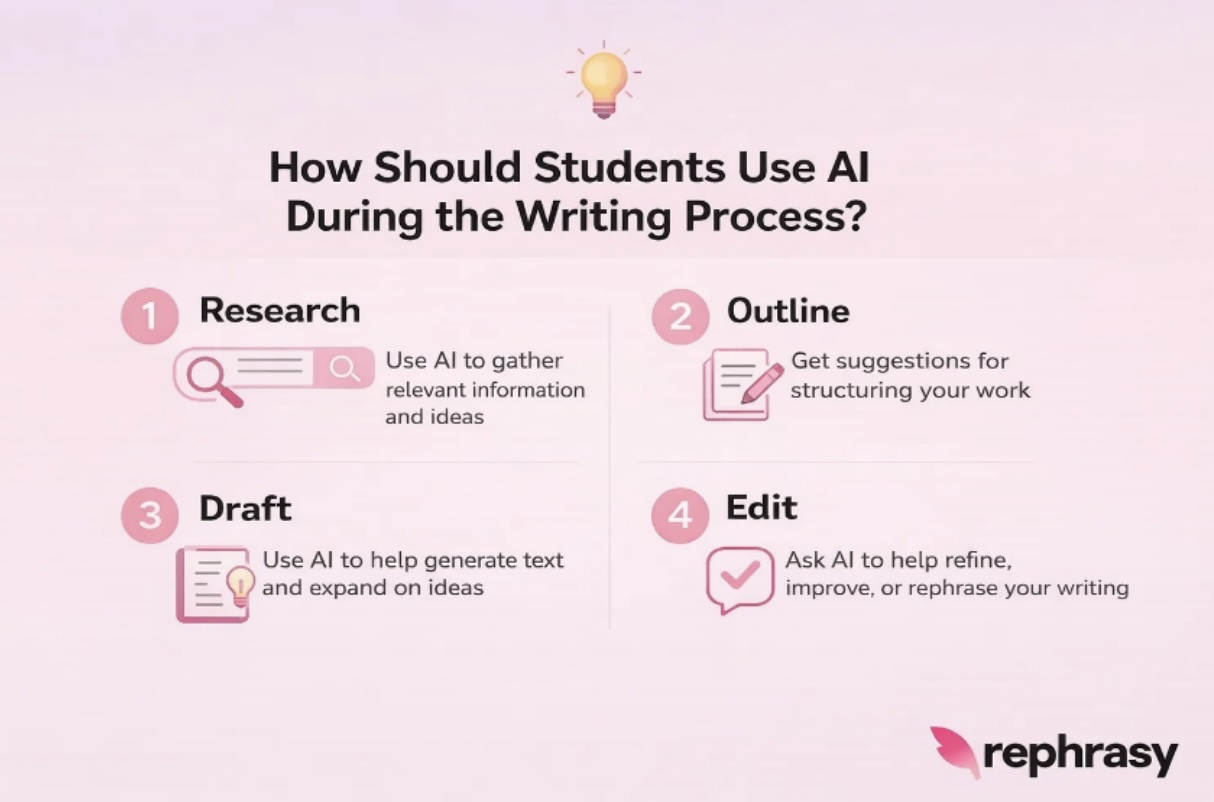
Students should mainly try their best to use AI during planning and editing stages rather than always relying on it mainly during final writing.
AI will always work best when it helps organise thinking rather than replacing it. Many successful students now integrate AI into early writing stages where it improves structure without affecting originality. A smart approach is using AI to reduce effort in preparation while keeping the writing stage human. This keeps assignments authentic while still benefiting from efficiency.
This also supports natural conversion of AI to human text because you are shaping the content instead of relying on it directly.
A step-by-step AI-assisted writing workflow
A structured process tends to basically make AI use safer and even more effective. Students who will follow a process will always produce stronger academic work simply because they maintain control at every stage no matter what. A reliable process includes:
Research topic manually first
Use AI to generate outline ideas
Write your own draft
Use AI for clarity improvement
Rewrite important sections
Proofread carefully
Can AI-Generated Writing Be Used Without Problems?
Yes, but only after rewriting and verifying the content yourself.
AI-generated writing often sounds structured but generic. Using it safely requires transforming it into something that reflects your understanding and writing style. This process reduces both academic risk and detection concerns.
Students who directly submit generated text usually face the most issues. Students who rewrite deeply usually avoid problems because the final work becomes their own genuinely.
This is why many students explore tools described as the best AI humanizers, although manual rewriting still produces the strongest results.
How to safely rewrite AI-generated text
Rewriting is about changing the entirety of the thinking structure. Students should mainly focus on improving clarity, simplifying explanations, and connecting ideas to their coursework. This naturally makes writing more authentic.
Strong rewriting usually involves changing sentence flow, adding examples, and connecting arguments to the course material rather than relying only on paraphrasing tools.
Do AI Detectors Mean Students Should Avoid AI Completely?
No, AI detectors do not mean students must avoid AI but rather they simply mean students must use it responsibly.
Detection tools are designed to identify patterns, not punish AI use itself. Universities are more concerned with whether students understand their submissions than whether AI was involved in early drafting.
Understanding how AI detectors vs. AI humanizers differ helps clarify this. Detection tools estimate patterns while humanizing approaches improve readability. Neither replaces academic evaluation.
Students who focus only on avoiding detection often miss the bigger point, which is demonstrating knowledge.
How AI detectors usually evaluate writing
Detection tools tend to basically analyze the overall structure rather than simply looking at facts.
They typically look at:
Predictable sentence construction
Uniform paragraph structure
Vocabulary patterns
Writing probability scores
These signals do not prove AI use. They only estimate likelihood, which is why professors usually review work manually before making decisions.
Can AI Writing Be Made Undetectable?
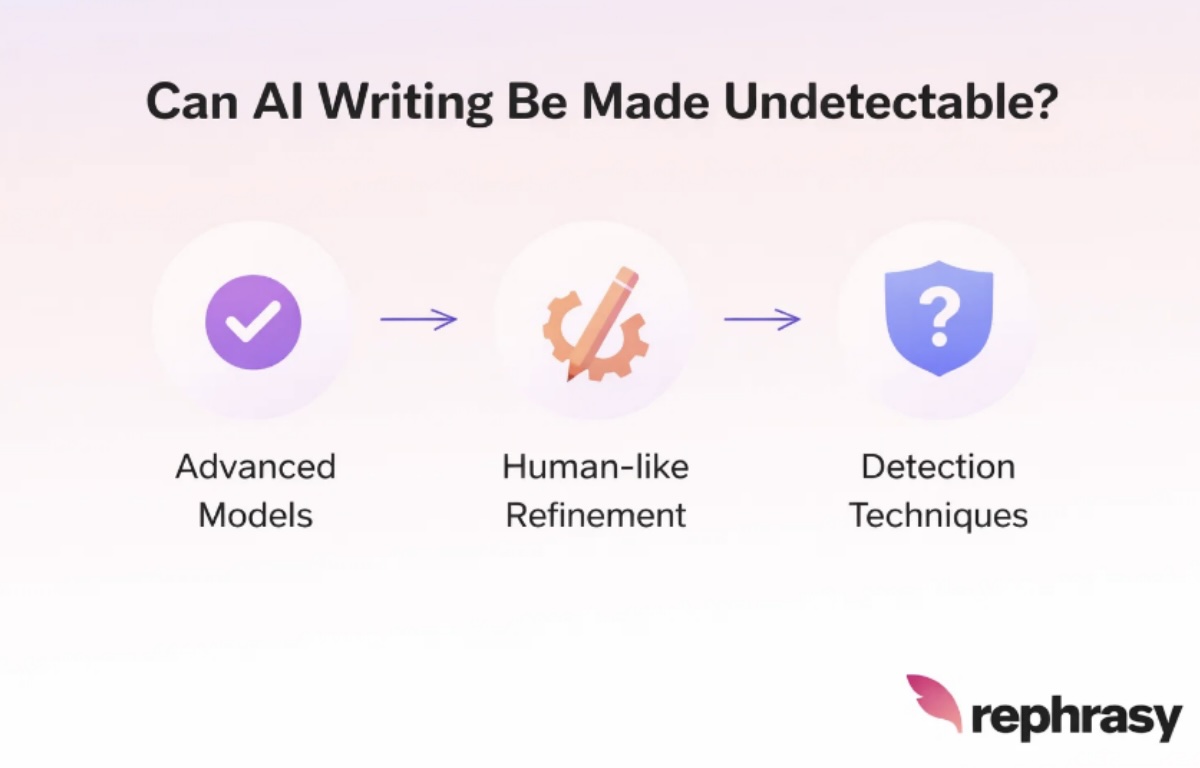
No method will ever fully guarantee undetectable AI writing, but rewriting and understanding greatly reduce risk.
Students often search whether AI humanizer can bypass turnitin, but the safest approach is always improving authenticity rather than trying to bypass systems.
Writing that shows understanding, personal reasoning, and course knowledge rarely creates academic concerns, regardless of whether AI helped in the early stages or you ended up relying on yourself fully.
What actually lowers detection risk
Detection risk decreases when students actively improve their writing rather than trying to disguise it. Effective improvements include:
Adding lecture references
Including personal interpretation
Simplifying overly formal language
Verifying all facts
Removing generic phrasing
These steps improve quality rather than simply masking patterns.
Should Students Use AI Editing Tools Before Submission?
Yes, AI editing tools can improve clarity when used as a final review step.
Editing tools can help identify overly complex sentences, repetitive phrasing, and structural issues. Used properly, they function like advanced grammar assistants rather than shortcuts.
Some students use what is marketed as an AI detector remover workflow, but the best use is treating these tools as readability checks rather than avoidance mechanisms.
Where editing tools fit in a safe workflow
Editing should only always happen right after you’ve already basically written and rewritten your work again. A strong workflow should follow this general order of writing your draft, rewriting important sections, improving clarity, checking structure, and then proofreading it further altogether.
How Much Editing Does AI Content Really Need?
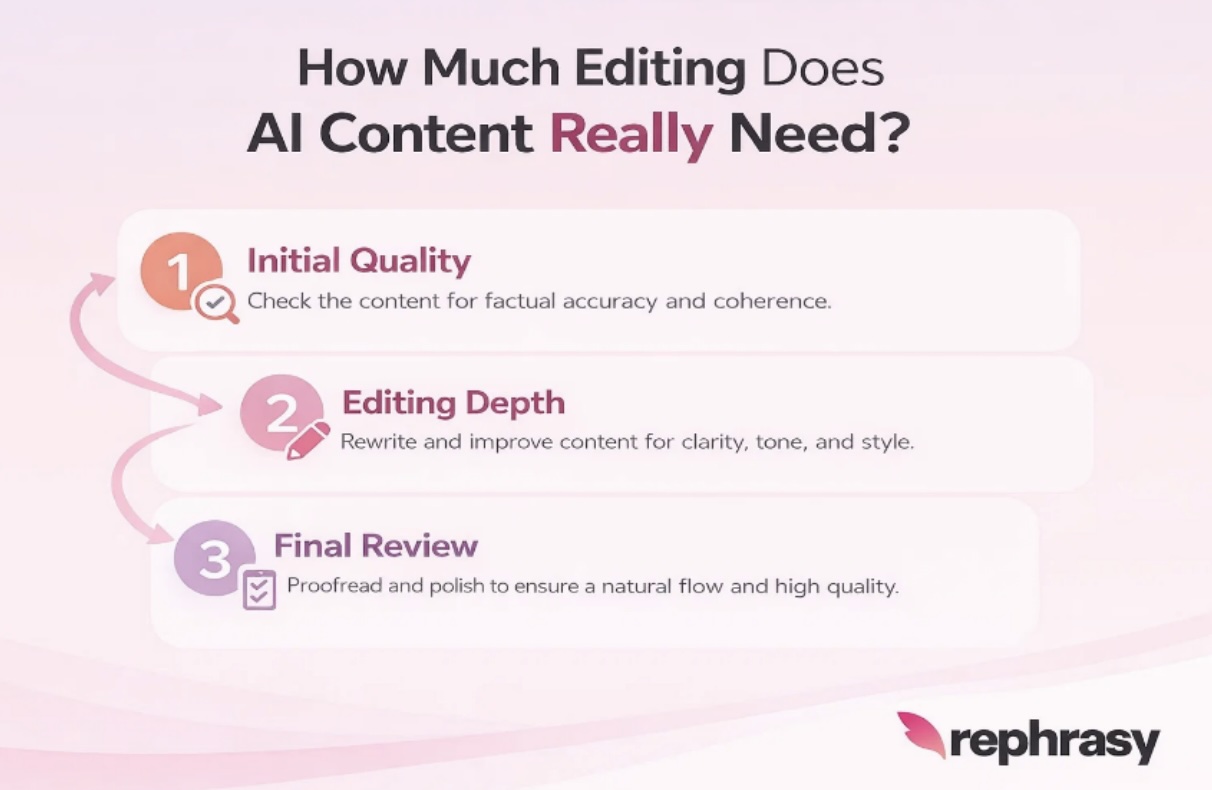
AI content usually needs significant editing to meet academic standards.
Generated writing often explains topics clearly but lacks depth, critical thinking, and course relevance. Editing allows you to add these missing elements and strengthen your arguments. Students who spend time improving reasoning rather than just changing wording usually produce stronger assignments.
What Mistakes Make AI Usage Unsafe?
AI becomes risky when students rely on it too heavily or stop thinking critically.
Most academic problems related to AI come from predictable behaviour such as submitting generated essays or failing to verify content. These issues are avoidable with simple habits. Understanding these risks will usually always help students use AI more strategically.
The most common unsafe AI writing habits
Students often create problems when they:
Submit AI text without editing
Fail to check sources
Use AI for entire assignments
Ignore course material
Depend on rewriting tools only
Avoiding these habits usually keeps AI use within acceptable boundaries.
AI Tools Students Can Safely Use for Writing Support
Some AI tools are designed to improve writing rather than generate it.
Students often benefit from grammar assistants, clarity tools, and research summarisation tools more than full writing generators. These improve quality without affecting originality. Tools such as Rephrasy.ai can surely help improve readability, but they should always be combined with personal editing.
Comparing AI writing support tools
Different tools will always serve different purposes, let’s take a look at it:
Tool Type
| Best Use
| Risk Level
|
Outline generators
| Planning structure
| Low
|
Grammar tools
| Clarity improvement
| Very low
|
Full generators
| Draft creation
| Medium
|
Humanizing tools
| Readability improvement
| Low
|
How Universities Expect Students to Use AI in 2026
Universities increasingly expect students to know how to use AI responsibly rather than avoid it. Academic policies are evolving to reflect the reality that AI will remain part of education. Many institutions now focus on transparency, understanding, and responsible use.
Students who learn how to integrate AI properly often gain advantages because they work more efficiently without sacrificing originality.
Skills students should develop when using AI
Students should focus on developing skills that AI cannot replace. These will always include from the following:
Critical thinking
Argument development
Research evaluation
Writing clarity
Independent reasoning
AI should support these abilities rather than replace them.
What Students Should Focus on Instead of Avoiding Detection
Students should focus on learning, clarity, and originality rather than detection avoidance. When writing reflects real understanding, detection concerns usually become secondary. Professors primarily evaluate thinking quality, not software scores.
This perspective shifts AI from being a risk to being a productivity tool. Students who succeed with AI usually focus on improving their writing process rather than trying to manipulate outcomes.
Should Students Tell Professors They Used AI?
Transparency is usually recommended, but it depends on university policy.
Many universities now include AI disclosure policies in their academic integrity rules. Some require students to declare AI use, while others only require disclosure if AI contributed directly to writing. This means students should always check their syllabus or institutional guidelines before deciding.
Being transparent does not mean you will be penalised. In many cases, responsible disclosure actually shows academic maturity and ethical awareness. Professors are typically more concerned about misuse than responsible use.
Understanding this also helps students move away from focusing on bypassing university AI detectors and toward demonstrating responsible academic behaviour, which is ultimately what institutions value more.
When disclosure of AI use is recommended
Disclosure is most useful when AI helps shape structure or research. For example, let’s say that if AI ever helped you organise your ideas or clarify a difficult concept, mentioning this may strengthen credibility rather than weaken it. It shows you used AI as a learning support rather than a replacement.
Students should consider disclosure when:
AI helped generate an outline
AI helped summarise research
AI helped improve clarity
AI was used for editing suggestions
When AI is only used for grammar corrections, disclosure is usually not required, similar to spellcheck tools.
How to mention AI use properly if required
If disclosure is required, it should be simple and factual. A short note such as stating that AI was used for outlining or editing is usually enough. Over-explaining is unnecessary. The focus should remain on the fact that the student produced the final work independently.
This approach also reinforces the idea that AI is a support tool rather than the author of the work.
How Can Students Balance AI Help With Their Own Writing Skills?
Students should use AI to support skill development, not replace it.
AI can either improve or weaken writing ability, depending on how it is used. Students who depend on AI for full writing often struggle to improve academically. Students who use AI to refine their writing often improve faster.
The difference comes down to involvement. When students analyse AI suggestions instead of blindly accepting them, they develop stronger writing instincts. This turns AI into a training tool rather than a shortcut.
This is also where understanding AI detectors vs. AI humanizers becomes useful. The real goal is not to outsmart detection but to improve how naturally you communicate ideas.
Ways AI can actually improve writing skills
AI can be really used as a simple feedback tool rather than a writing tool. Students can ask AI to simply explain why a paragraph is unclear, suggest ways to improve argument flow, identify weak transitions as well as to generally suggest clearer wording.
Signs you may be relying too much on AI
Students should occasionally check if they are becoming too dependent. Warning signs include:
Difficulty writing without AI
Accepting suggestions without review
Not understanding generated explanations
Writing becoming inconsistent with your ability
If this happens, reducing AI use temporarily can help rebuild independent writing confidence.
How to Check If AI Content Matches Your Writing Style
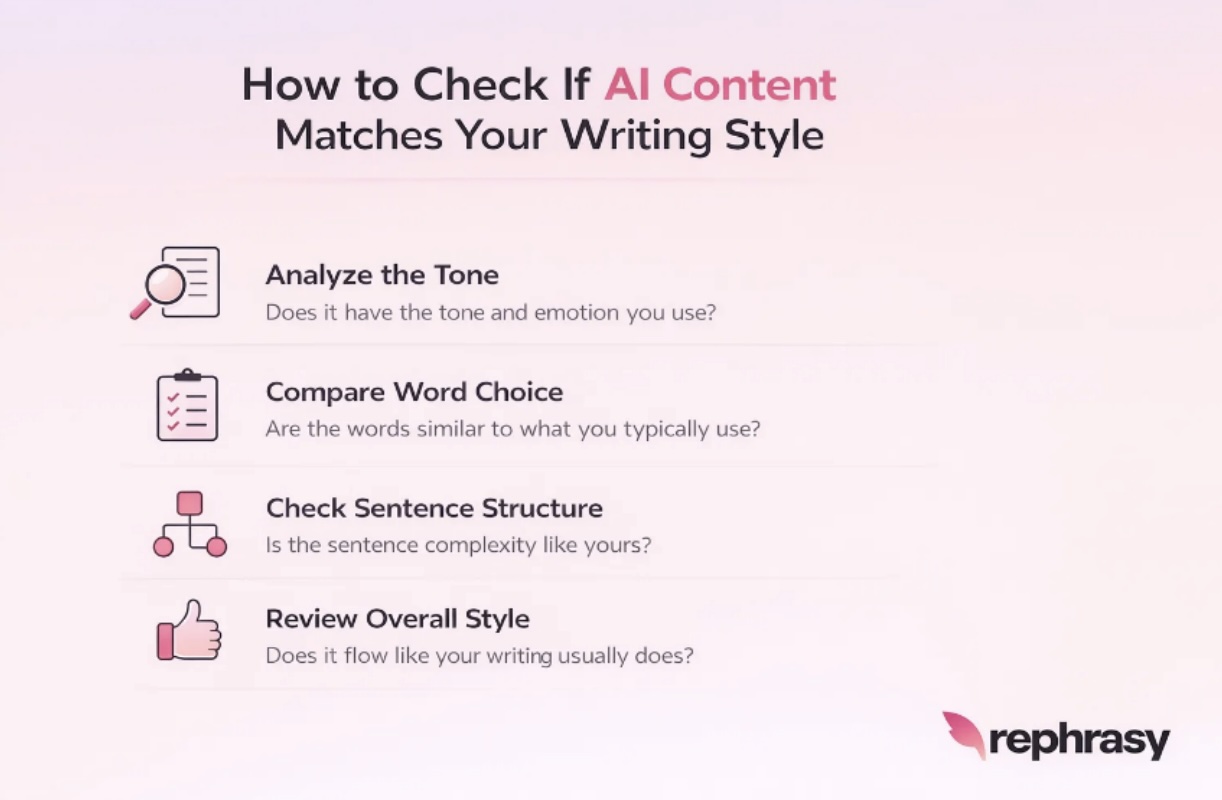
Students should always make sure that AI-assisted writing matches their normal writing level.
One of the biggest mistakes students make is submitting writing that sounds very different from their previous assignments. Even without detection tools, this can raise questions because professors often recognise their students’ writing patterns.
Matching style is not about making writing worse. It is about keeping tone, vocabulary, and explanation depth consistent with your natural academic voice. This is also where converting AI to human text becomes important because the goal is not just rewriting but aligning the writing with your thinking style.
Practical ways to align AI writing with your voice
The best method is simply reading your work out loud. If something sounds unnatural when spoken, it usually needs revision. Students should also compare new work with past assignments to check consistency.
Useful adjustments include:
Simplifying overly formal language
Adding natural transitions
Breaking complex sentences
Adding your own explanations
These changes make writing feel more authentic.
Why natural writing variation matters
Human writing is rarely perfectly balanced. AI often produces paragraphs of similar length with consistent sentence structures. Adding natural variation improves readability and authenticity.
This is why students sometimes use tools described as the best general AI humanizers, but manual editing still produces better alignment with personal style.
How to Review AI-Assisted Work Before Submission
Students should always review AI-assisted work carefully before submitting assignments. Reviewing is where safe AI use is determined. Most academic issues happen because students skip the review stage and submit content too quickly.
A careful review ensures accuracy, originality, and clarity. It also ensures the student understands everything written. This matters more than any technical detection concern. Some students use what is marketed as an ai detector remover process during review, but the real value comes from careful reading rather than relying on automated scores.
Conclusion
AI writing tools can be used safely when students remain active participants in their assignments. The safest approach is simple. Use AI to organise ideas, clarify concepts, and improve writing. Do not use it to replace thinking or effort.
Students who succeed with AI usually follow three principles. They stay involved in writing. They verify information. They make the final work their own.
As AI becomes more common in education, the students who benefit most will not be those trying to avoid it. They will be those who know how to use it responsibly while maintaining academic integrity.
When used correctly, AI becomes a powerful assistant rather than a shortcut. The difference always comes down to how responsibly it is used. Now that you know how to use AI writing tools safely, don’t abuse them!
FAQs
1. Is using AI for assignments considered cheating?
No, using AI is usually acceptable if you remain involved and follow your university guidelines.
2. Can AI writing be detected easily?
Sometimes, but detection is also mainly based on probability rather than certainty.
3. Should students rewrite AI-generated text?
Yes, as rewriting will make sure that your content is original and understandable.
4. Are AI humanizers enough to make writing safe?
No, understanding and editing matter more than tools alone.
5. What is the safest way to use AI tools?
Use AI for structure and editing, then write and verify the content yourself.