ChatGPT Watermark Remover
Remove the
ChatGPT Watermark
Rewrite ChatGPT text so OpenAI's invisible textGrain watermark is gone, along with the style patterns AI detectors flag.
Rewrite ChatGPT text so OpenAI's invisible textGrain watermark is gone, along with the style patterns AI detectors flag.
By clicking 'check AI score' or 'Humanize', you agree to our terms and conditions and privacy policy. The detector scores are based on finetuned models!
Your History
0Nothing here yet.
Humanized texts show up here automatically.
WHAT IS TEXTGRAIN
On October 5, 2026, OpenAI announced textGrain: a statistical watermark hidden in the words ChatGPT picks. You can't see it, and copy and paste doesn't remove it. A detector with OpenAI's secret key measures how closely the word choices follow that key.
ChatGPT and Codex for users in the EU, rolling out from October 2026 to meet Article 50 of the EU AI Act. API developers worldwide can switch it on. It is off by default.
A secret key nudges which of several plausible words the model picks. Each choice reads naturally, but across a few hundred words the pattern becomes measurable.
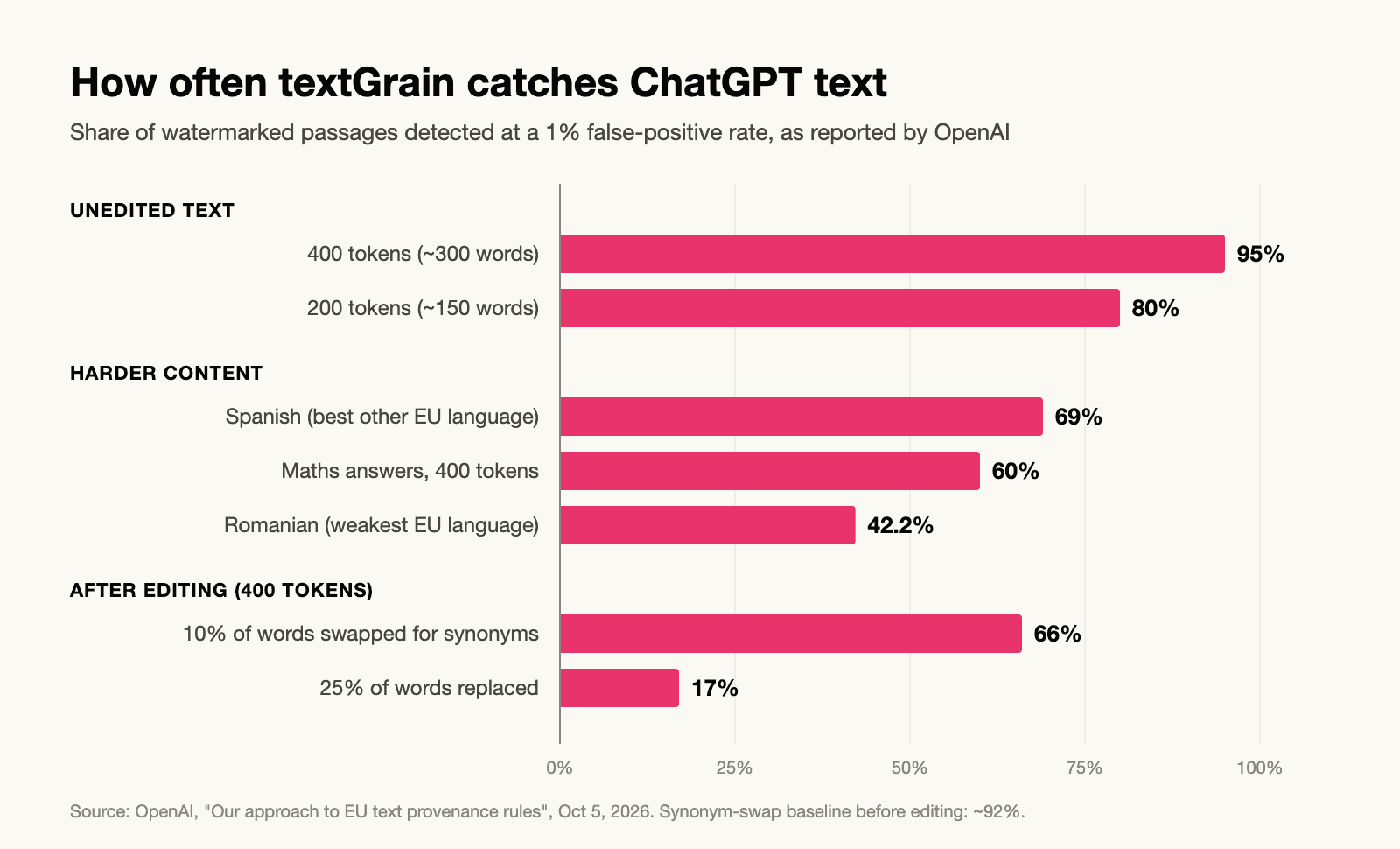
Outputs under 200 tokens, roughly 150 words, are not watermarked.
According to OpenAI, the watermark shows that text came from its model, not who generated it.
OpenAI's own figures: around 95% of unedited 400-token passages are detected. Once a quarter of the words are replaced, detection drops to 17%. The signal lives in word choice, so changing the words removes it.
WHO CAN DETECT IT
Right now, almost nobody. OpenAI's detector is limited to approved researchers and expert organisations because of the risk of false positives and false negatives.
Detecting textGrain requires OpenAI's secret key. Without approved access, no tool can measure the actual watermark signal.
Tools that promise a textGrain score without explaining their access, data or error rates are most likely returning a generic AI-detection score. That can be useful, but it is not the watermark.
GPTZero, Turnitin, Pangram and Originality don't read watermarks. They judge writing style, and they are what most teachers, editors and platforms run today.
Verification pending official OpenAI detector access
Rephrasy has applied for access to OpenAI's textGrain detector. Once approved, we will publish before-and-after results here. Until then we only claim what OpenAI's own data supports: the more of a text is genuinely rewritten, the less of the watermark remains.
HOW IT WORKS
A synonym spinner touches 5 to 10% of the words, and OpenAI's data shows the watermark survives that. Rephrasy rewrites sentence structure, order and vocabulary across the whole text.
Any length, in any EU language. Text under about 150 words isn't watermarked anyway.
Every sentence is regenerated with new word choices, so the keyed pattern in the original wording is replaced, not just diluted.
Run the result through the built-in AI detector to see how it scores on the classifier tools readers and teachers actually use.
FAQ
Yes, in the EU. From October 2026, OpenAI adds its textGrain watermark to eligible ChatGPT and Codex text for EU users. Outside the EU it is off for now, but API developers can turn it on.
No. There are no hidden characters and no metadata. The watermark is a statistical pattern in word choice that only a detector with OpenAI's secret key can measure.
Not the watermark itself. OpenAI's detector is limited to approved researchers and organisations, and Turnitin, GPTZero and Pangram don't read watermarks. They judge writing style, which Rephrasy also addresses.
No. The signal is in the words themselves, so it survives copying into Word, Google Docs or a CMS.
Change the words. OpenAI reports that detection falls to 17% once a quarter of the words are replaced. A full rewrite with Rephrasy changes much more than that. Light synonym swapping does not.
Be cautious. OpenAI has not made its detector public, and checking for textGrain requires its secret key. Tools without approved access can't measure the real watermark and usually return a generic AI score.
Yes. Anthropic has watermarked text from new Claude models worldwide since August 2026, and Google marks Gemini text with SynthID. Each company uses its own scheme and key.
ChatGPT watermark: the full guide
How textGrain works, OpenAI's detection numbers and what it means if you write with AI.
Remove SynthID from images
ChatGPT and Gemini images carry Google's SynthID. Remove it with a diffusion pass.
SynthID detector & explainer
How Google's SynthID watermark works across text and images.
Remove it inside ChatGPT
Connect Rephrasy to ChatGPT or Claude and rewrite text without leaving the chat.
Convert AI to Human Text — Free AI Humanizer
The #1 AI humanizer trusted by 200,000+ students & professionals