Most people using AI for SEO make one major mistake, and it is simply that they try to treat AI as a replacement for writing instead of a production assistant. The difference ends up then showing up in rankings. Content that follows a structured optimisation workflow consistently outperforms content that is simply generated and published and that’s the truth.
Our guide fully explains a professional SEO workflow used by content teams that successfully combine AI speed with human optimisation. Ready to learn all about how to create SEO-optimised blogs using AI? Let’s get started!
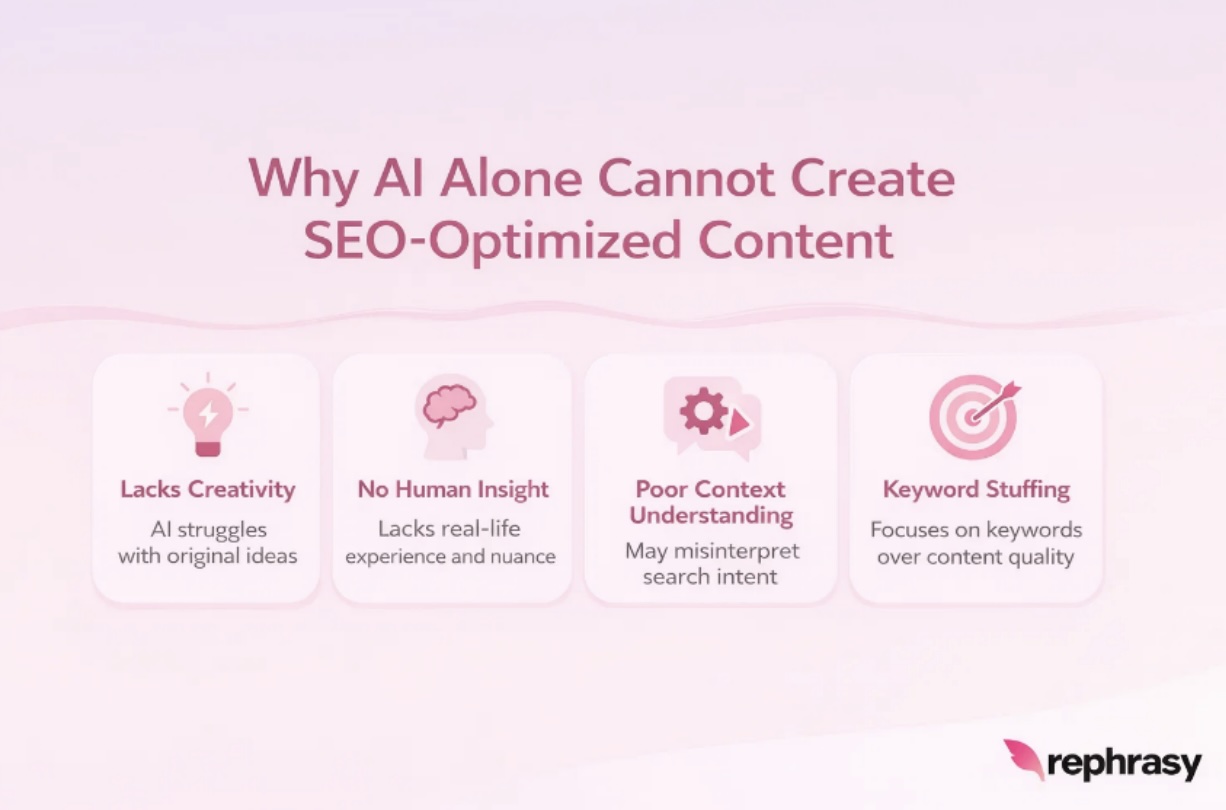
Why AI Alone Cannot Create SEO-Optimized Content
It’s truly no secret that AI alone cannot create SEO-optimized content and it’s all because of how ranking tends to depend on strategy, not just text generation. AI models generate information based on patterns, but they do not understand competition, search behaviour, or ranking difficulty. Without direction, AI tends to produce safe informational summaries rather than strategically positioned articles.
This is why experienced editors treat AI output as a first draft rather than a finished article. The real SEO value comes from shaping that draft around search intent, keyword clusters, and topical completeness.
This process is similar to the difference seen in discussions around AI detectors vs. AI humanizers, where tools may assist output quality but cannot replace editorial strategy.
What AI does well in SEO writing
AI is extremely effective when used correctly within the workflow. It performs best at generating topic coverage, creating outlines, expanding explanations, and suggesting structural ideas. These strengths make it valuable in the early stages.
AI works especially well for:
Where AI needs human guidance
One thing that you’ll note is that AI mainly struggles most with strategic positioning. It cannot accurately judge competition strength, ranking intent, or brand positioning. These decisions require human oversight.
This is why professional workflows often include a checklist for AI-assisted content to ensure strategic alignment before publishing.
How to Select SEO Topics That AI Can Actually Rank For
AI can only really ever rank when the topic selection is realistic and properly aligned with search demand. Many writers choose topics based on interest rather than opportunity. SEO requires identifying topics with achievable competition levels and clear user demand.
Topic selection should always happen before AI writing begins, as this will always prevent wasted effort on articles that have little ranking potential.
How to identify SEO-friendly AI blog topics
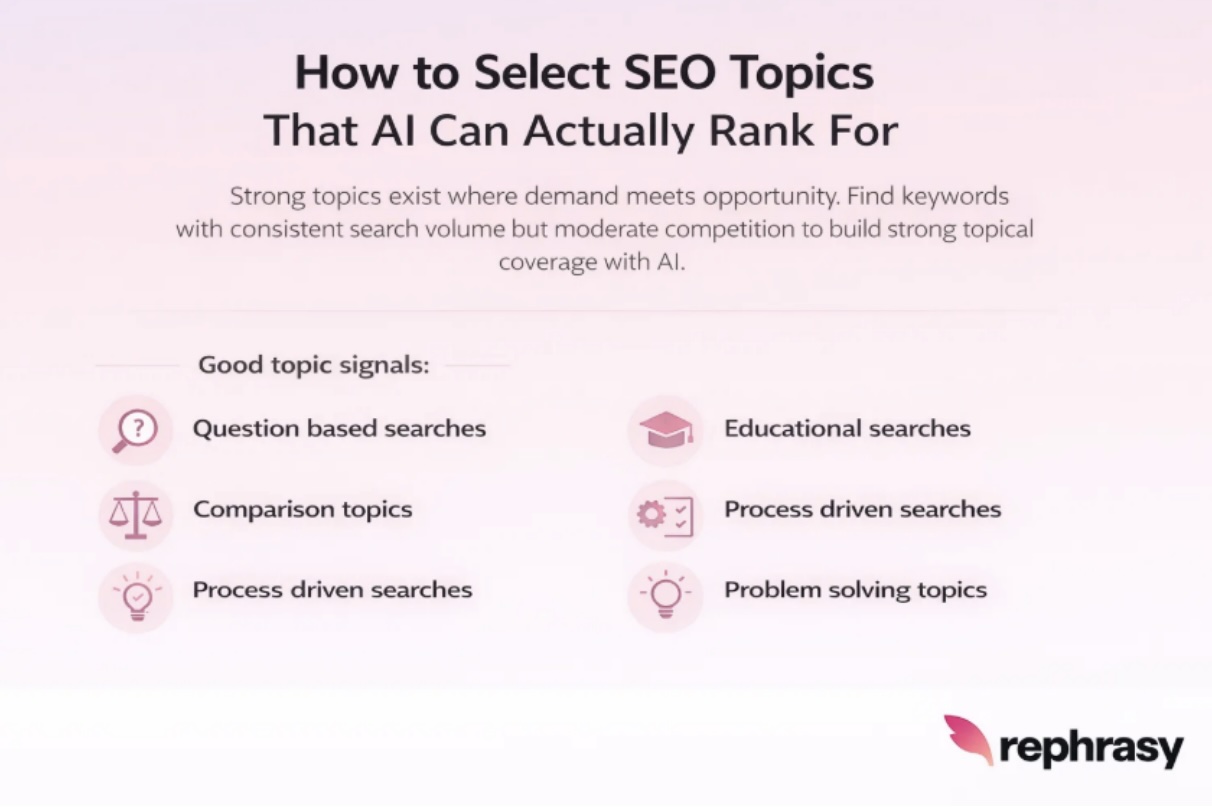
Strong topics usually exist where demand meets opportunity. This means finding keywords with consistent search volume but moderate competition. AI can then be used to build strong topical coverage. Good topic signals tend to include the following:
Question based searches
Comparison topics
Educational searches
Process driven searches
Problem solving topics
Why search intent matters more than keyword volume
Traffic potential is really, really meaningless without intent alignment. A lower volume keyword with strong intent often performs better than a high volume keyword with an unclear purpose. This is why articles discussing practical questions like can AI humanizer bypass Turnitin often perform well because they answer direct curiosity.
How to Build a Search Intent-Driven Outline Before Using AI
Creating an outline first will simply make sure that AI produces properly structured rather than repetitive content. AI tends to repeat ideas when given broad instructions. Providing a clear heading structure forces the draft to cover specific areas rather than repeating general explanations.
One thing is that professional SEO writers spend more time outlining than drafting. This ensures the article answers all related questions within the topic cluster.
How to design a strong AI SEO outline
An effective outline should actually reflect how readers explore a topic. This usually means starting with fundamentals, moving into processes, then covering practical applications and concerns.
A truly reliable outline will mostly include introduction, context, the explanation of core concepts, practical workflow, common mistakes, as well as advanced tips, and then a conclusion.
Why outlines prevent thin content problems
Thin content usually comes from poor planning. When AI generates without structure, explanations often lack depth. A structured outline forces topic coverage. This also improves opportunities to naturally include supporting topics like ai to human text when discussing content refinement stages.
How to Generate a High Quality AI Draft Using SEO Prompting
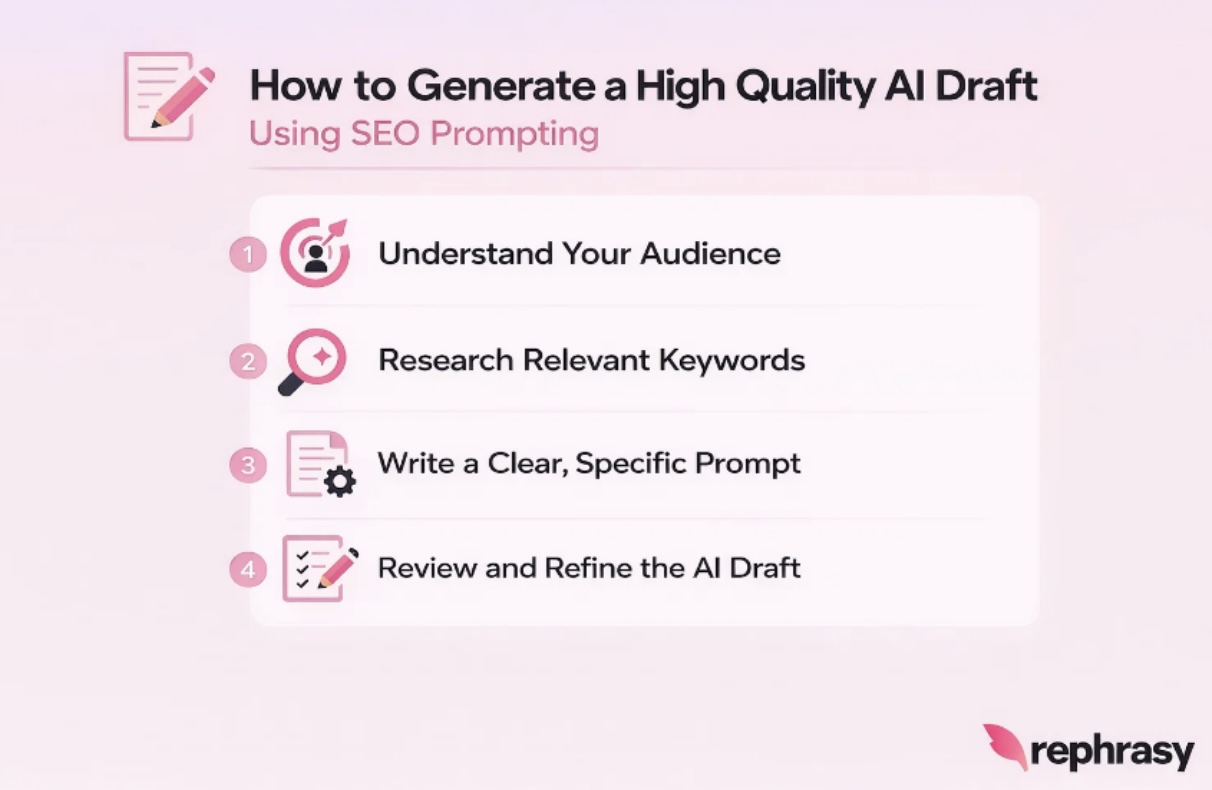
AI will always produce very strong drafts when prompts include structure and expectations. What happens is that most weak AI content comes from vague prompts. Asking AI to “write an SEO article” usually produces surface-level information. Strong prompts tend to define structure, audience, and depth. This turns AI into a guided writer instead of an uncontrolled generator.
What information should be included in AI SEO prompts
If there’s one thing to keep in mind is that detailed prompts produce clear, better drafts. And the most important instructions include the target keyword, target audience, content depth level, heading structure, and expectations of the tone.
By providing this info, it will dramatically improve the quality of the first draft.
Why structured prompting reduces editing time
Better drafts reduce rewriting workload. When AI receives strong direction, editing becomes refinement instead of reconstruction. This improves workflow speed.
This approach often produces better results than relying solely on rewriting tools marketed as the best AI humanizers.
How to Expand AI Content to Meet Topical Authority Standards
Topical authority really does improve anytime the main content covers related questions thoroughly. Google increasingly rewards comprehensive coverage rather than isolated explanations. This means strong articles answer not just the main keyword but surrounding questions.
How to identify missing subtopics
Missing subtopics usually appear as unanswered questions. Review competing articles and identify gaps where AI can then be prompted to fill those areas. Subtopic opportunities will often include:
Definitions
Processes
Comparisons
Common mistakes
Practical applications
How to Humanise AI Content Without Damaging SEO Signals
AI content should be humanised carefully so keyword relevance remains intact. Over editing can sometimes remove keyword relevance or change structure in ways that reduce SEO strength. The goal is improving readability while maintaining optimisation.
This is why many editors balance readability improvements with keyword preservation rather than aggressively rewriting everything.
Where human editing should focus first
A clear thing is that human editing should always, always prioritise clarity improvements. Try your best to focus on improving transitions, simplifying sentences, and improving explanation flow. These changes improve engagement without harming optimisation.
Editors sometimes compare manual editing against tools labeled as an AI detector remover, but structural improvements usually produce better results.
How to Optimise AI Content for Featured Snippets and SERP Features
Featured snippets often come from clearly structured explanations. Search engines will more often than not tend to extract short answers from well-structured content. This means clear definitions and direct explanations improve visibility opportunities.
AI can help produce these answers when instructed to provide concise explanations within structured headings.
How to structure content for snippet opportunities
Direct answers will always improve the snippet chances. A few strong snippet structure will always include clear definitions, short explanations, as well as headings that are very clearly question-based.
Why direct answers improve search visibility
Search engines have always favoured clear answers. And this is mainly why placing simple explanations under headings will always improve usability and SEO performance.
How to Build Internal Linking Strategies Using AI Content Clusters
Internal linking improves SEO by connecting related content topics. AI articles should not exist alone as they should support a content cluster strategy where related articles strengthen overall topical authority.
This is where supporting discussions, like bypassing university AI detectors may naturally connect with broader AI writing strategy content.
What makes a strong internal linking structure
Strong linking connects relevant topics naturally. Important principles include linking related guides, connecting educational topics, and reinforcing expertise areas.
How to Perform a Professional AI Content Quality Audit Before Publishing
Every AI article should pass a quality audit before publishing. Publishing without review increases the general risk of factual errors, weak structure, or unclear messaging. Professional teams always include final review stages.
A simple professional AI content review checklist
A strong review process usually include from the following:
Fact checking
Tone alignment
SEO verification
Structure review
Grammar correction
How to Scale SEO Blog Production Using AI Without Losing Quality
Scaling content requires scaling review processes, not just production speed. Many teams will simply fail anytime they increase AI production without increasing quality controls. This leads to declining content standards. What successful teams do is that they tend to build repeatable workflows instead.
The balance between scale and quality
Scale works only when standards really do remain stable. This usually means creating editing frameworks and review guidelines. On top of that, systems tend to also create quality that is really, really predictable. And with that, predictability can easily improve brand trust and ranking stability.
Conclusion
Creating SEO optimized blog posts with AI is really all the more about workflow discipline. What AI does is that it only tends to provide speed, but having a proper kind of structure provides actual results.
Writers who succeed with AI usually follow a clear process. They research keywords first, build structured outlines, generate drafts strategically, and refine content carefully before publishing. The advantage does not come from producing more content. It comes from producing better-structured content consistently.
AI will continue evolving, but the main sort of fundamentals of SEO will remain rooted in usefulness, clarity, and topical authority. Writers who understand how to guide AI instead of relying on it will consistently produce stronger content. Now that you know how to create SEO-optimised blogs using AI, do it properly!
FAQs
1. Can AI content rank without editing?
Yes, it is safe if you use AI as a support tool rather than a replacement for your own thinking. Always review, edit, fact-check, and personalise the output to make sure that it truly does reflect your understanding and complies with your institution’s academic integrity policies.
2. Can universities detect AI-generated content?
Yes, many universities use AI detection tools, but these tools are not always fully accurate. This is why it is important to revise AI content, add your own insights, and ensure the final work reflects genuine human input rather than raw AI output.
3. Should I rewrite AI content before submitting it?
Yes, you should always rewrite or heavily edit AI content. Adding your own examples, adjusting the tone, improving clarity, and verifying facts helps make the work original and academically appropriate.
4. What is the best way to make AI content sound human?
The best approach is to edit for natural flow, add personal reasoning, vary sentence structure, and remove generic phrasing. Reading the content aloud is also a simple way to spot robotic wording and improve readability.
5. Can AI help with research as well as writing?
Yes, AI can help summarise concepts, explain difficult topics, suggest outlines, and generate research directions. However, you should always verify information using credible academic sources before including it in your work.