Most AI text sounds correct but is mainly forgettable. It often lacks the subtle writing signals that show experience, intent, and perspective. This is why many editors spend more time refining AI output than generating it. The real skill today is not using AI. The real skill is shaping AI content so it reflects a clear human identity.
This guide explains how to systematically transform robotic text into natural writing using a clone-writing-style method. Instead of random editing, you will learn a repeatable framework that allows you to scale content while maintaining authenticity. Ready to learn how to add personality to AI-generated content? Let’s get started!
Why AI-Generated Content Often Lacks Personality
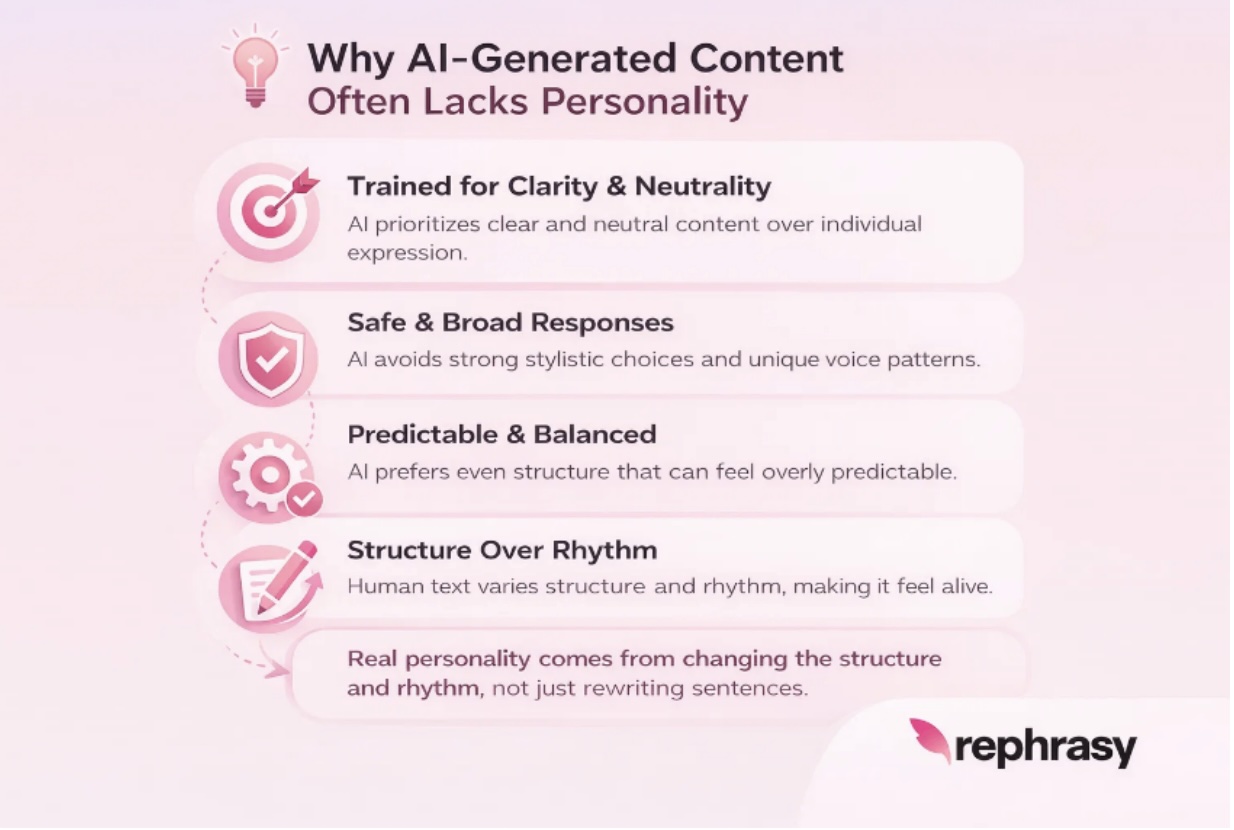
AI content lacks personality because it is mainly trained to prioritize clarity and neutrality over individual expression.
AI models are always specifically designed in order to produce safe responses that work for broad audiences. This means they avoid strong stylistic choices, distinctive phrasing, or unique voice patterns. While this makes content readable, it removes the small imperfections that make writing feel real.
Another major reason might simply be that of predictability. AI prefers balanced paragraphs, evenly structured explanations, and very safe transitions. Human writing rarely follows such a predictable rhythm. Real writers vary sentence length, sometimes emphasise certain ideas, and occasionally break structural patterns to improve flow.
This is why many editors focus on converting AI to human text rather than simply rewriting sentences. The real transformation happens when structure and rhythm change, not just vocabulary.
What makes writing feel human instead of generated
Human writing usually contains variation, intent, and just a tad hint of subtle imperfection that makes it even more beautiful.
Readers will almost always recognise natural writing through pacing differences, emphasis decisions, and depth in the general explanation. AI tends to flatten these differences unless guided carefully. Signs that content may feel artificial include the following:
Why personality improves SEO and reader trust
Personality increases engagement signals, which indirectly support SEO performance.
Search engines increasingly measure usefulness and reader satisfaction rather than just keyword presence. Content that feels natural tends to keep readers engaged longer.
This is also why discussions around AI detectors vs. AI humanizers often miss the larger picture. The real objective is not just avoiding detection. The real objective is improving readability and usefulness.
What Is a Clone Writing Style and Why Does It Matter?
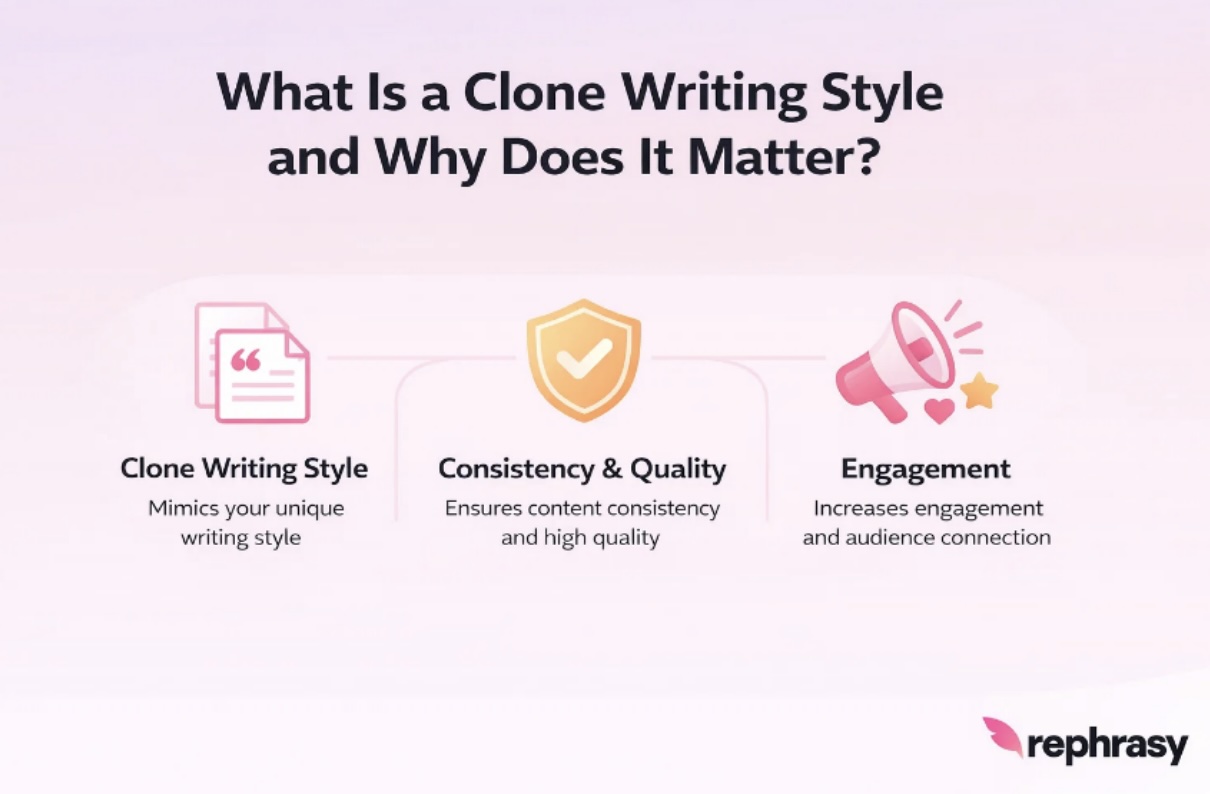
A clone writing style is basically that of a repeatable system for making AI content consistently sound like you.
Your writing voice is entirely built from something known as patterns. These include how you explain ideas, how formal your tone is, how long your sentences typically are, and how you structure paragraphs. Once these patterns are identified, they can be applied to any AI-generated draft.
This process allows writers to scale production without losing identity. Instead of sounding different in every article, your content maintains recognizable consistency.
Many writers try relying on tools advertised as the best AI humanizers, but true consistency usually comes from understanding your own writing habits rather than depending on automation.
The core elements that define writing voice
One thing to note is that voice is not really just one characteristic, but rather it is a combination of multiple small habits.
Key elements include tone preference, explanation depth, transition habits, and sentence rhythm. Some writers naturally explain things step by step. Others prefer concise summaries. Some use conversational phrasing while others stay formal. Understanding these tendencies allows you to edit AI content strategically instead of randomly.
How to reverse engineer your personal writing style
Perhaps one of the easiest ways to identify your voice is by reviewing your previous work.
Look at several pieces you wrote without AI assistance. Identify similarities in structure and tone. Do you prefer direct explanations? Do you avoid overly complex vocabulary? Do you tend to use shorter paragraphs? What happens is that this automatically then fully becomes your style blueprint.
How to Train AI to Match Your Voice Instead of Rewriting Everything
AI matches your voice better when you provide examples rather than general instructions.
Most users simply ask AI to sound human. This produces inconsistent results because the instruction is vague. AI performs better when given a writing sample and asked to replicate tone patterns. This basically will continue to reduce the general editing time significantly because the draft already reflects your structure preferences.
This also reduces the need to worry about bypassing university AI detectors because naturally personalized content rarely resembles generic AI output.
A simple prompting method that professionals use
Providing structured instructions improves output quality dramatically. A reliable method includes:
Providing a short writing sample
Asking AI to analyse tone and structure
Requesting rewriting in that style
Manually refining the result
Why human editing still matters after good prompts
Even the best prompts rarely produce perfect alignment. AI may match structure but miss emphasis. It may match vocabulary but misspellings. This is why editing remains necessary. You can basically think of prompting as shaping raw material rather than producing a finished product.
How to Add Natural Flow and Imperfection That Makes Content Feel Real
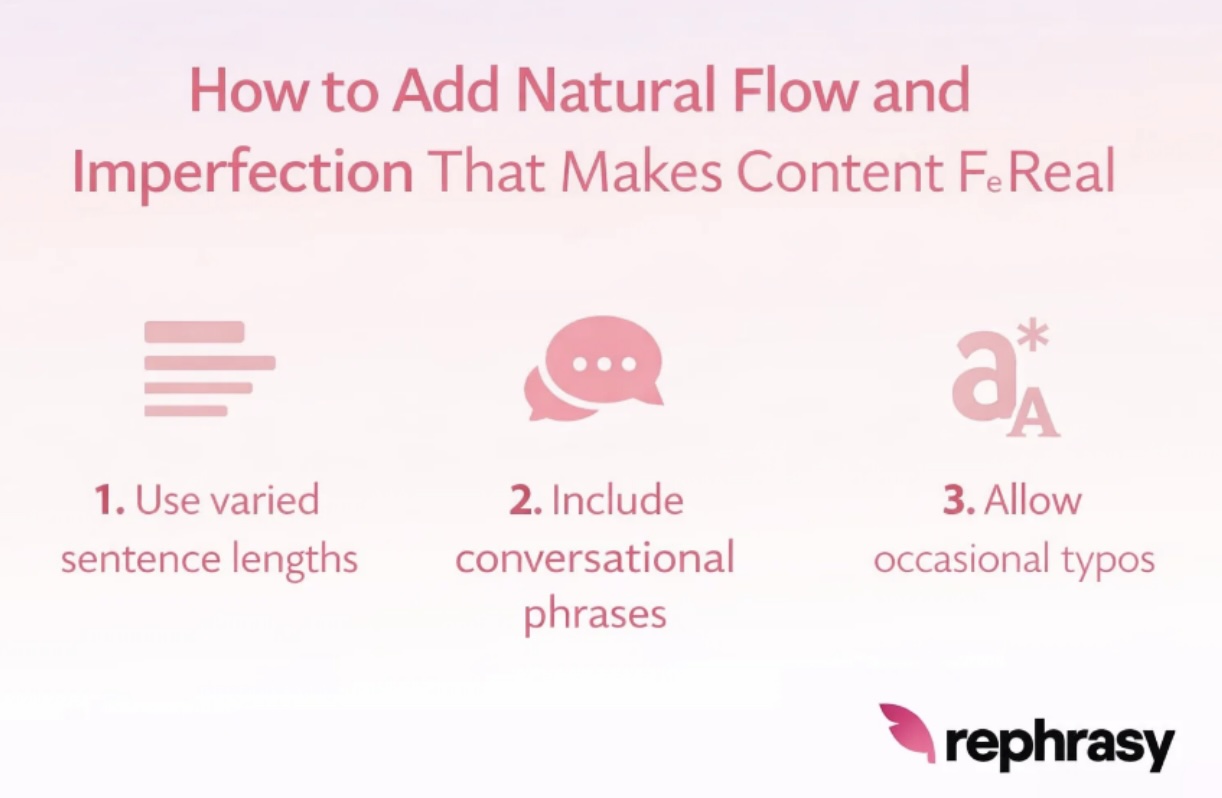
Human writing feels authentic because it contains natural variation rather than mechanical balance. AI tends to smooth everything into a predictable structure. Humans naturally introduce rhythm changes. Some sentences are short for emphasis. Others are longer for explanation.
Adding this variation is one of the fastest ways to improve AI writing quality. This is why some editors experiment with tools labelled as an AI detector remover, but manual rhythm adjustments usually produce stronger results.
Simple structural adjustments that improve authenticity
Small structural edits often outperform major rewrites. Effective adjustments include:
Mixing short and medium sentences
Removing repetitive transitions
Adding emphasis sentences
Combining overly similar paragraphs
These changes create natural reading flow.
Why writing rhythm affects reader engagement
Readers process text through pacing. Basically, anytime that each sentence follows the same structure, reading becomes predictable. Natural variation keeps attention active. On the long-term, this becomes especially important in long-form content where reader fatigue can reduce engagement.
Give Your AI Content a Personal Touch with Rephrasy’s Clone Writing Style
AI writing is really fast and efficient, but without a personal touch, it can feel really generic and robotic. That’s where Rephrasy’s Clone Writing Style comes in! This tool easily helps you inject your unique voice, tone, as well as style into every piece of content that you create.
Whether you’re writing blogs, emails, social media posts, or reports, Rephrasy will make sure that your AI content sounds unmistakably like you. Here are the all the cool features it has.
Fast Training
Time is truly precious, and you don’t need to wait hours for an AI to learn your style, as Rephrasy eliminates the need for it. With fast training, your custom AI model will be ready in just a few minutes.
The AI will quickly be able to learn your unique phrasing, tone, as well as sentence structure. The result? It produces content that flows really naturally, and reflects your personaltiy perfectly.
Affordable Customisation
One of the most remarkable things about Rephrasy is that it doesn’t ever charge for cloning your writing style. You can create as many custom voices as you like, all without ever paying a cent out of your own pocket.
Have you got different tones for different types of writing? No problem! You might have a rather warm, friendly tone for blog posts and a more professional tone for reports.
Seamless Integration
Managing multiple writing styles used to be really clunky, but Rephrasy makes it so easy, and with seamless integration, you can easily switch it out between the Humanizer and your custom styles in a few clicks.
Whether you’re editing a blog post or drafting a persuasive email, Rephrasy’s intuitive interface makes sure that you’re always in control.
How it Works
Adding personality to AI-generated content sounds complicated, but Rephrasy makes it simple. Here’s how it works:
Step 1: Choose a Preset
Start by properly selecting a present that matches your content type, as Rephrasy offers three options:
Conversational: This is friendly, and pretty casual, which makes it rather perfect for personal blogs or community-focused posts.
Paper: This is best for professional and structured settings, as it’s ideal for articles, or reports.
Marketing: It’s best for personal ideas, and is designed to connect with your audience.
Step 2: Provide Sample Sentences
Next, you’ll provide a few sentences written in your own style. These samples act as a blueprint for the AI, teaching it how you phrase ideas, structure sentences, and convey tone. The more representative your examples are, the better the AI can mimic your style. Think of it as showing the AI how you write naturally rather than forcing it to guess.
Step 3: Train the AI
Now, once you end up submitting your samples, Rephrasy will then train the AI model in just a few minutes. The system will learn your unique voice, creating a custom profile that can write just like you instantly. And this step is where the true magic happens! Your personal style is ready for you.
Step 4: Start Writing
Finally, it’s time to put your custom AI to work. Apply your cloned style to blog posts, social media updates, emails, reports, or even marketing campaigns.
Every piece of AI-generated content now carries your personality, tone, and voice, making it indistinguishable from something you wrote yourself. The best part is that you end up saving time while maintaining consistency across all your writing.
How to Add Perspective Without Damaging Accuracy
Adding perspective improves authority when supported by facts. AI tends to present information neutrally. Human writers often explain why something matters. Adding interpretation improves usefulness without reducing credibility.
This is also why many professional teams maintain a checklist for AI-assisted content to ensure added perspective remains accurate.
Safe ways to introduce personality into informational writing
Personality does not require informal writing. You can simply add your own kind of voice by explaining the general importance, highlighting mistakes, adding your own practical insights, or even clarifying any areas that are really, really confusing. These additions improve value without making writing subjective.
How to avoid sounding opinionated instead of authoritative
Authority comes from explanation rather than assertion. Instead of stating conclusions directly, explain reasoning behind them. This keeps writing in an educational rather than argumentative.
How AI Humanizers Fit Into Professional Editing Workflows
AI humanizers can assist editing but should not replace manual review. Many rewriting tools promise instant natural tone. Some improve readability. Others only change synonyms without improving structure.
Understanding when to use these tools prevents quality loss. This is also mainly why writers tend to frequently research whether an AI humanizer can bypass Turnitin, but quality should always come before detection concerns.
Situations where AI humanizers help most
They are most useful for surface improvements. A few examples would include stuff like improving flow, reducing repetition, simplifying wording, and improving readability. They should never be trusted for argument structure or factual editing.
How to Build a Professional AI Editing Workflow
A structured editing workflow ensures consistent results across all content. Without a process, editing becomes inconsistent. Some sections receive attention while others remain generic. A system prevents this.
Professional writers treat AI editing as quality control rather than casual revision. This mindset matters more than comparing tools within various discussions.
A proven multi-pass editing system
Professional editors will often follow a sequence-based review, where any kind of reliable structure would include clarity review, tone alignment, properly optimising the general structure, and then reviewing everything altogether.
How to Make AI Content Sound Conversational Without Losing Authority
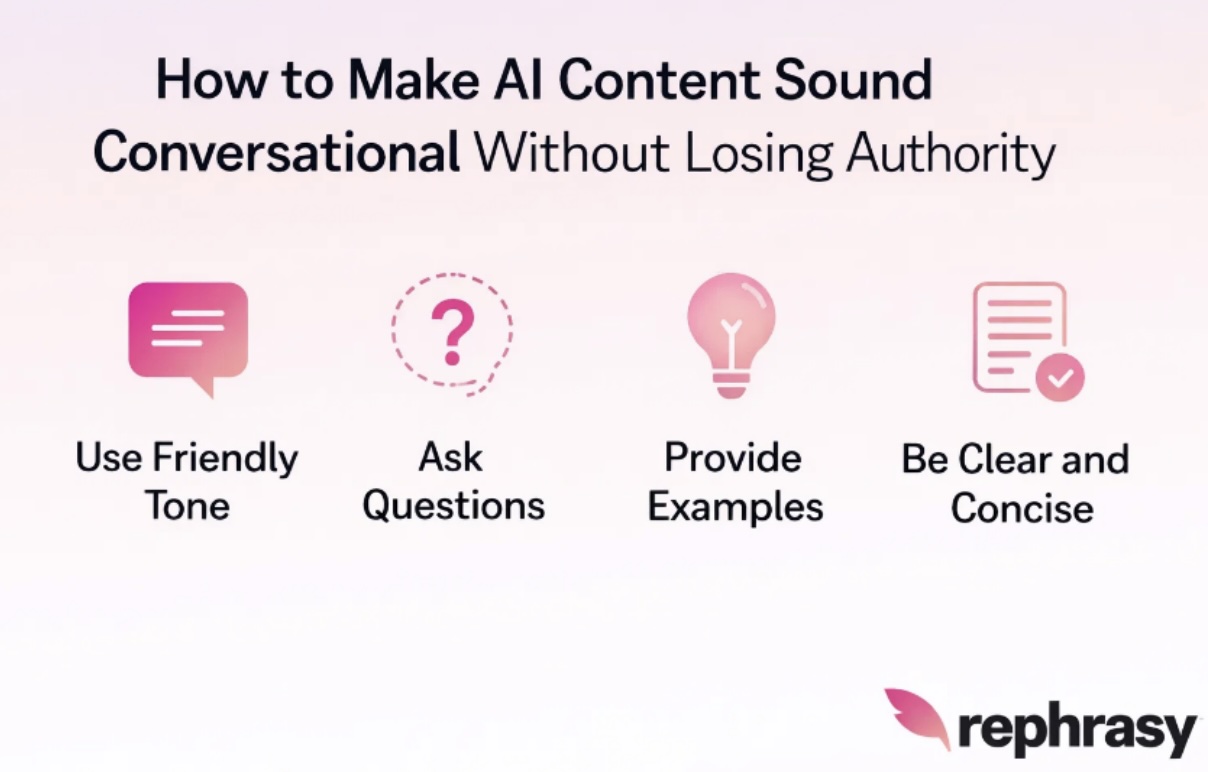
Conversational writing improves clarity without reducing professionalism. Conversational tone does not mean casual writing. It means writing that flows logically and explains ideas naturally. Even academic writing benefits from this clarity.
Many editors focus only on wording changes when converting AI to human text, but tone adjustments often create bigger improvements.
Techniques that generally improve the clarity of conversation
Practical adjustments here would include:
Using direct explanations
Removing any complexities
Using transitions that are mostly natural
Clarifying any technical wording
How to Maintain Voice Consistency Across Large Documents
Consistency becomes harder as content length increases. Short articles are easier to control. Long documents often develop tone variation if edited in sections. This is why final review passes are important.
Maintaining consistency also does tend to generally reduce any kind of concerns related to bypassing university AI detectors because a consistent tone is a natural human writing trait.
What voice consistency actually involves
Consistency involves structural patterns rather than just vocabulary. Check for tone, explanation depth, paragraph structure, and transition habits. These factors matter more than synonym variation.
How to Develop a Signature Editing Style That Scales Content Production
A signature editing process allows teams to scale content without losing quality. Writers who develop consistent editing habits can transform AI drafts faster and more effectively. Instead of reinventing editing strategies for each article, they apply the same refinement steps every time. This is how professional agencies maintain quality across hundreds of articles.
How Professionals Balance AI Speed With Human Creativity
One thing to always note is that AI basically provides speed while humans provide originality. Writers who rely entirely on AI often produce forgettable content. Writers who combine AI speed with human insight usually produce high-performing material. Try to remember that this balance is what separates basic AI usage from professional implementation.
Conclusion
Adding personality to AI-generated content is not about disguising automation. It is about improving communication quality. Writers who understand how to refine AI output instead of relying on it blindly consistently produce stronger content.
The most effective strategy combines structured prompting, deliberate editing, and voice consistency checks. Tools may assist the process, but writing quality still depends on human judgment.
Writers who develop a clone writing style approach usually find they spend less time fixing content and more time improving it. Their writing becomes more recognisable, more engaging, and more trustworthy.
The long-term advantage does not come from chasing detection avoidance techniques or experimenting endlessly with rewriting tools. It comes from learning how to combine efficiency with authenticity. Now that you know how to add personality to AI-generated content, use it wisely!
FAQs
1. Can AI generated content truly sound human?
Yes, but only when properly edited for tone, rhythm, and natural variation.
2. Do AI humanizers completely fix robotic writing?
No, they help with flow but manual editing is still necessary for voice consistency.
3. Is changing vocabulary enough to humanise AI content?
No, structure and tone matter more than word replacement.
4. Should writers worry about AI detection when adding personality?
Natural editing usually reduces detection risks without needing technical workarounds.
5. What is the fastest way to improve AI writing quality?
Focus on general clarity, sentence variation, and consistent tone rather than heavy rewriting.