How to Use ChatGPT Without Getting Detected: Simple Tips
Learn how to use ChatGPT without getting detected with these simple tips. Enhance your writing, avoid AI flags, and stay ahead in the evolving AI landscape.

Rephrasy Team
Sep 3, 2024
Learn how to use ChatGPT without getting detected with these simple tips. Enhance your writing, avoid AI flags, and stay ahead in the evolving AI landscape.
Rephrasy Team
Sep 3, 2024

Many AI writing tools, such as ChatGPT, have really changed how students may approach essays. What used to normally take days of research as well as drafting can now be really started in minutes. But while the technology is really, really powerful, many students still do worry about one thing, which is getting flagged by AI detection systems.
Remember that the real issue here is not using AI, but using it incorrectly. This is why most universities are not really trying to ban AI completely. Rather, they want to prevent any kind of specific misuse. Students who treat AI as a shortcut will often run into trouble, while students who treat it as a basic study assistant usually don’t.
Our guide will tell you just exactly how to use ChatGPT for essays in a way that improves your writing but still allows you to stay within academic expectations. On top of that, it will also explain how to make sure your essay still sounds like your own work and reflects real understanding. Let’s get started.
Most universities do allow limited AI assistance, but they fully expect you to do the final thinking, editing, and writing.
At this point, policies have really changed quickly over the past two years. Many institutions do now accept AI for the sole purpose of researching and brainstorming. What they usually prohibit is submitting essays that are fully generated without actually understanding the material.
This shift reflects a rather practical reality. How so? As AI is now part of the writing process, the focus now is no longer on banning tools but rather on how responsibly they are used.
On top of that, students who succeed with AI usually follow one simple rule. Use it to support your work, not just replace it.
AI is usually acceptable anytime it helps further the process of learning rather than simply replacing it.
Most academic policies now allow students ot use AI for understanding difficult concepts, structuring essay outlines, improving general grammar, and generating any starting points for your research.
What they tell you to stay away from is submitting AI-generated essays, generating fake citations, avoiding reading course materials, and using AI without editing.
This is why many discussions around bypassing university AI detectors miss the real point. The real goal should be demonstrating understanding, not trying to hide tool usage.
What AI detectors do is that they exist solely to promote academic integrity, not to just punish students who are responsible.
Universities aim to confirm whether students truly understand what they submit, if their work reflects actual learning, and if the grades represent the knowledge. Detection tools are just one method. Professors also look for sudden writing style changes, vague arguments, and an inability to explain submitted work.
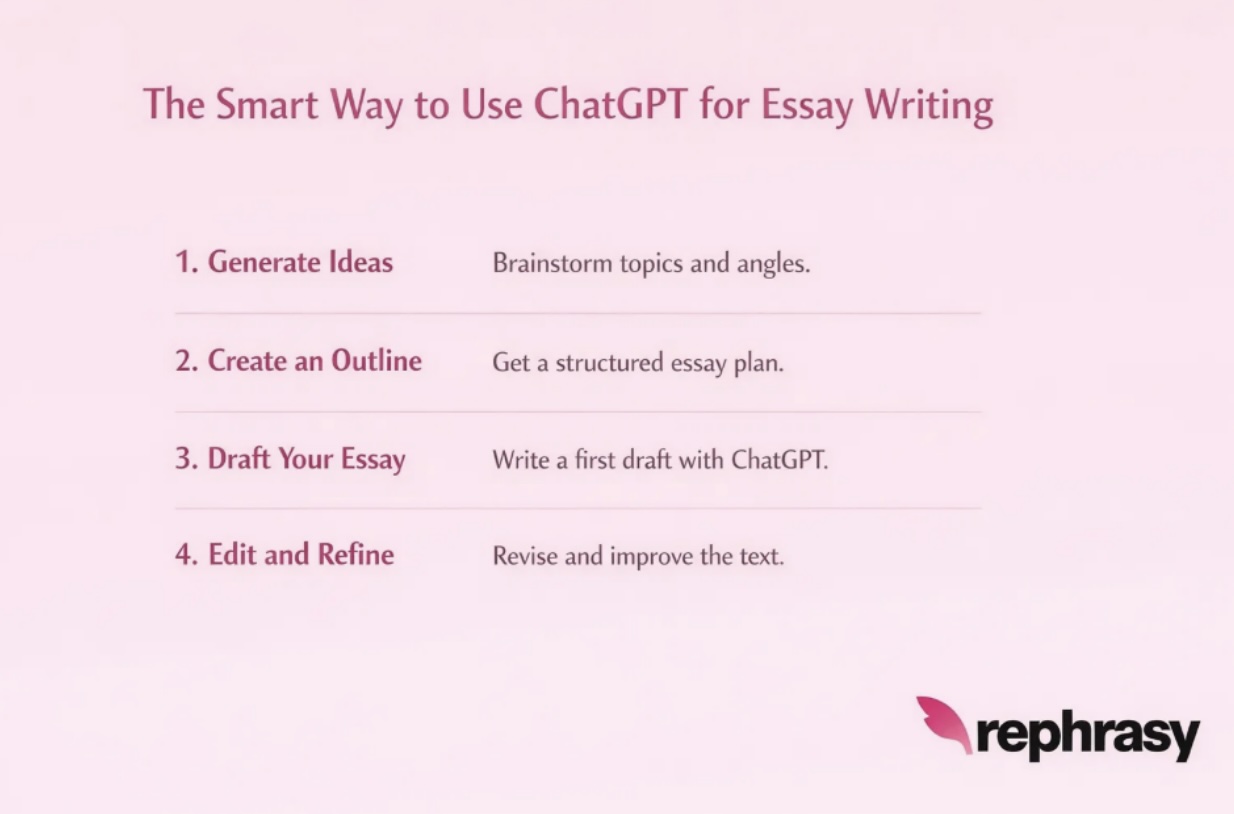
The safest way to use ChatGPT is as a starting point, not to use it as an endpoint. Smart students who avoid problems usually tend to follow a workflow that keeps them in control of the writing process. Instead of asking ChatGPT to write the essay, they use it to organize their thinking and clarify their sense of direction.
What this approach does is that it produces better essays, stronger arguments, and fewer detection concerns because the intellectual ownership truly does remain with the student at the end of the day.
Outlines are probably one of the safest and most effective ways that you can use AI. Here’s how you do it, instead of asking it to write your essay on climate change, ask it to help you create an outline for an essay about climate change that focuses on economic impacts.
This is what a good AI-generated outline should always look like:
Introduction structure
Main arguments
Supporting ideas
Possible conclusions
After that, you can write the actual essay yourself, which will make sure that your voice stays consistent throughout the work.
Remember, AI always works best as a tutor rather than as a ghostwriter for you. If a topic feels truly confusing, what you can do is to ask ChatGPT to explain it in simple language for you. After that, you can write your own explanation based on what you understand, as this will reinforce the idea of learning and reduce dependence on content that is fully generated.
Treat AI as your personal editor. For example, instead of generating text, you can ask it to improve the clarity of a certain paragraph for you.
After using AI suggestions, always manually adjust wording, examples, or explanations so the final version reflects your own thinking rather than sounding like a polished but generic draft.
With it, this will keep your ideas intact while improving the overall readability. Many experienced students have now started to treat ChatGPT as an editing assistance rather than a writing engine because this maintains a sense of ownership while still improving the final quality.
Usually, strong rewriting includes changing sentence structures, replacing generic phrasing, adding specific examples, breaking long sentences, and combining any short ones.
AI text sometimes sounds very generic. The key here is to transform it so it reflects your voice and thinking style. This process is sometimes described as an AI-to-human text workflow because the goal is to generally turn AI output that is rough into authentic writing that reflects your personal understanding.
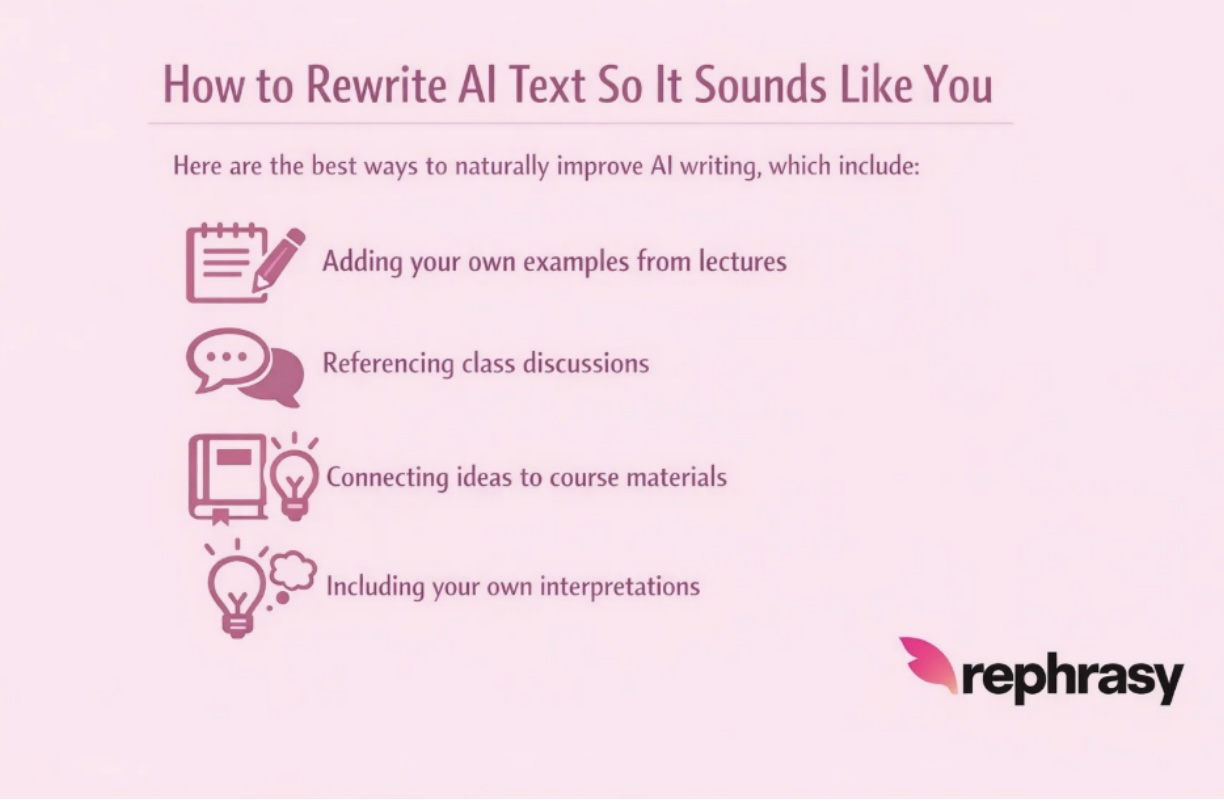
Here are the best ways to naturally improve AI writing, which include:
Adding your own examples from lectures
Referencing class discussions
Connecting ideas to course materials
Including your own interpretations
At this point, many students also explore the best AI humanizers to refine tone, but these should support rewriting rather than to simply go ahead and replacing it. The strongest results usually come from combining human editing with selective use of such tools.
Another effective technique is deliberately varying your writing rhythm by mixing short and long sentences, changing paragraph flow, and adding small personal observations where appropriate, since natural human writing rarely follows perfectly consistent patterns.
True rewriting will include restructuring ideas, not just relying on the replacement of vocabulary. This is because replacing words without changing the structure often keeps the same AI patterns, which means simple rewriting tools sometimes fail to improve overall originality.
AI detection is very misunderstood. Most students think that detectors will look for copied content, rather most tend to actually look for a few specific writing patterns.
Understanding this really does change how you approach writing because it can very easily shift the focus from avoidance to improvement.
AI detectors analyze a few things, such as:
Overall predictability of sentences
Vocabulary patterns
Consistency in the general structure
Probability scores
This does not really confirm if AI is used or not, but rather, it just gives an idea. This is why discussions around AI detectors vs. AI humanizers have become common. One tries to identify patterns, while the other focuses on improving how the writing reads and flows naturally.
Detection tools can sometimes very easily flag human writing or miss AI writing. This mainly happens because human writers can sound really structured, while AI can sound natural after editing.
Because of this, many educators will tend to treat detection as one signal rather than final proof, which means that writing quality still carries more weight than any overall score.
The better question here is rather whether the writing sounds natural, not whether a tool can bypass detection. Students often search whether AI humanizer can bypass turnitin or not, but improving general clarity and originality is usually more reliable rather than trying to manipulate detection outcomes.
Anytime writing feels natural and tends to reflect real understanding, the detection risk will typically decrease without needing to rely on shortcuts.
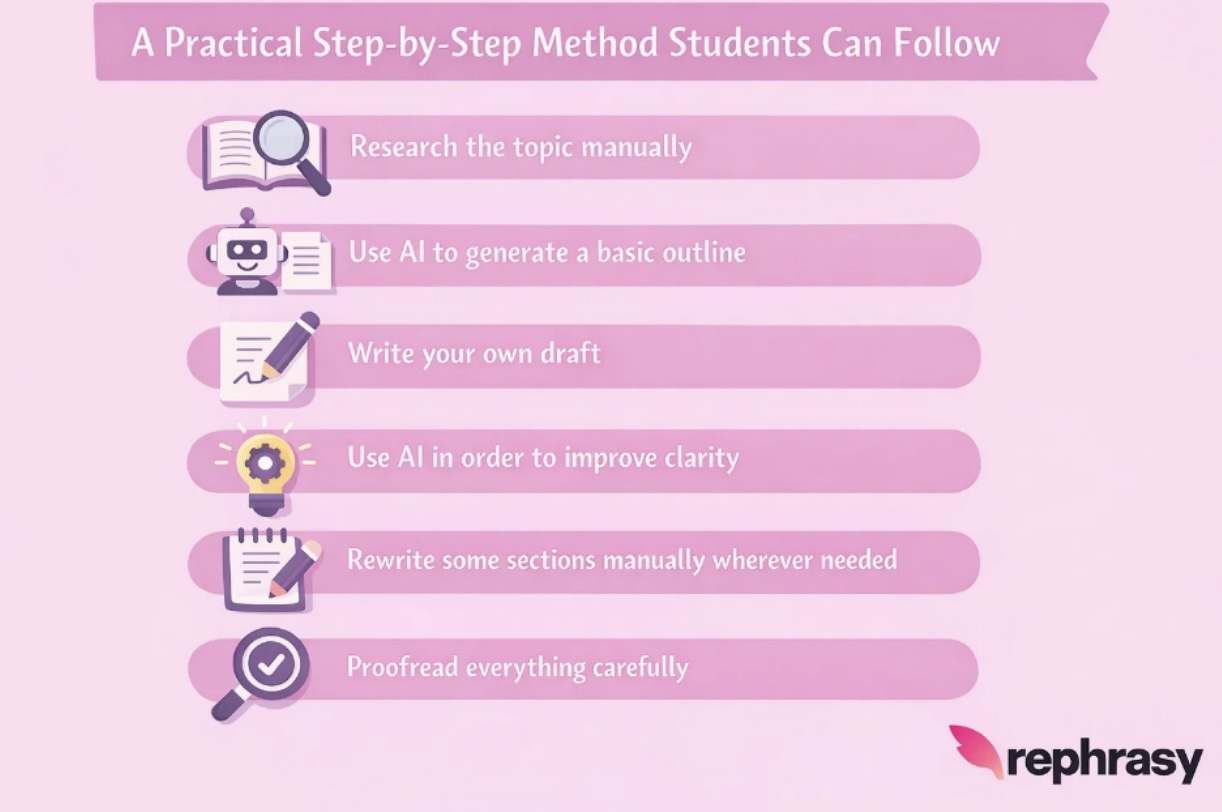
Students who tend to avoid problems will always follow a proper workflow rather than experimenting randomly. Remember that a consistent process will always reduce general mistakes and improve overall results. Here’s what a reliable process looks like:
Research the topic manually
Use AI to generate a basic outline
Write your own draft
Use AI in order to improve clarity
Rewrite some sections manually wherever needed
Proofread everything carefully
Many students informally follow a checklist for AI-assisted content such as that of:
Did I write most of this myself?
Do I understand every argument?
Did I change structure and wording?
Did I verify all info?
Would I be comfortable explaining this entire essay to my professor?
If your answer is yes to all of these, then the essay is usually safe. Some students also run their final draft through plagiarism or AI detection checkers simply as a precaution, not to game the system but to identify sections that may need clearer wording or stronger personal input.
The most common mistakes include submitting AI text without editing, relying too much on it, or using it to not learn the actual topic. Understanding these mistakes can easily help students to avoid unnecessary risks.
Unedited text will more often than not sound almost too consistent. It may include perfect grammar everywhere, uniform paragraph length, generic transitions, and lack of specific examples.
Students should also watch for repetitive transition phrases like "it is important to note" or "one key aspect is," since AI often reuses predictable wording that can make writing feel artificial if not rewritten.
Students sometimes generate multiple versions hoping one will pass. This often creates more problems because patterns remain similar. Instead, improving one draft usually works better than generating many versions.
The biggest risk here is submitting your work but not being able to explain it when you’re questioned about it. Professors will often ask follow-up questions, and if you can’t answer, then AI detection becomes irrelevant.
Remember that these tools should only be used as basic editing support, not as final shortcuts. Some students may use an AI detector remover after they have already rewritten their work, when its used this way, it will become a readability check rather than a lousy attempt to bypass it.
Some students also use AI humanizing tools to explore alternative phrasings or improve readability, but these work best when used after manual rewriting rather than as a replacement for personal editing.
A responsible writing workflow should look like a point where you write your draft, rewrite it manually, improve clarity, then recheck readability. This will keep improvement as the goal rather than avoiding learning the subject.
If each change always comes from tools, then the essay stop being coherent. Students should always read their essay out loud after making changes. This helps make sure that it still sounds natural and consistent with their writing voice.
Remember that not all AI usage leads to the same results. The difference will usually come down to general involvement and how much you actually know about the subject. Here’s a basic comparison:
Approach | Risk Level | Learning Value | Detection Risk |
Full AI essay | High | Low | High |
AI outline and self-writing | Low | High | Low |
AI editing only | Very low | High | Very low |
AI rewriting only | Medium | Medium | Medium |
The main way professors can tell if by noticing writing style changes, if your essay lacks depth, if you can’t explain your own arguments, or if you lack general knowledge about your own subject.
If your previous work was really simple and then it becomes highly structured, it might raise a few questions.
AI will often explain but will not argue on a topic much deeply, which is why adding your own reasoning, opinions and examples fixes this issues. It also shows that you’re genuinely engaging with the topic.
If you can’t explain your own essay verbally, it always suggests that you have weak ownership of the content. Try to understand the topic that you’re writing on so you can actually talk face-to-face with your professor about it when asked.
Here are a few of the best habits that students should follow to produce stronger work and have fewer problems with AI usage:
Treat AI as a tutor
Learn how to use ChatGPT for essays smartly
Verify all information
Add personal understanding
Prioritise clarity over shortcuts
Using ChatGPT for essays without getting caught is really about using it without needing to hide it. Remember that students who use AI to improve understanding, then structure their ideas, and even refine their writing, usually stay within academic expectations. Students who try to automate their entire workload often create unnecessary risks.
The safest approach is simple, which means that you should always stay as much involved in the writing process as possible. Anytime you focus on learning instead of shortcuts, AI will become your best friend.
The smartest students will not always be the ones avoiding AI. They will be the ones who know how to use it responsibly while still producing authentic academic work. Now that you know how to use ChatGPT for essays, use it smartly!
Convert AI to Human Text — Free AI Humanizer
The #1 AI humanizer trusted by 200,000+ students & professionals