On top of that, even experienced writers now tend to rely on some level of AI-assisted content creation, and that’s not really a bad thing. But, on the other hand, let’s not forget that acceptable doesn’t really mean unlimited use. The real question in 2026 is not whether you can use AI or not, it’s simply “how much will be considered too much?”
While some universities allowed limited AI help, some companies might encourage it fully, while some publishers might be highly against it, and you have no option but to comply. At the same time, AI detection tools are getting very strict, and AI content regulation discussions are growing across many, many industries.
So, where do we draw the line? The honest answer is really simple. AI is mainly acceptable anytime it helps your thinking, but not when it ends up replacing it. In our guide, we will break down exactly how much AI is acceptable in writing in 2026, when you should use it, when you should avoid it, etc. Ready to learn? Let’s get started.
How Much AI Is Actually Acceptable Today?
There isn’t a set limit, but generally, AI can be used just enough where it does not override your actual learning concepts and does not promote over-reliance.
Raw AI output is rarely acceptable, but if the content is properly edited, then it usually does become acceptable. It all sorts of boils down to your effort being put in.
How universities are changing to accept AI usage
Many universities now allow limited AI use as long as students still demonstrate understanding and originality. Now, the most common of rules tend to include the following:
AI is allowed for brainstorming
AI is allowed for editing
AI is not allowed for full submissions
Students must fully understand what they submit
Some students respond to this by trying to find ways around detection, which is why searches for bypassing university AI detectors have increased. But this usually backfires. Detection tools change constantly. What works today may fail tomorrow. More importantly, students who depend on bypassing systems often fail when asked to explain their own work.
Why some students focus on bypassing university AI detectors (and why that is risky)
The real problem with detection avoidance strategies is simply that they tend to focus on the wrong goal. The goal here should be to write better and generally try to edit better. Students who mainly focus on improving overall clarity and adding their own thinking will rarely run into problems.
How publishers and businesses evaluate AI-written content
Most businesses will never question you if you use AI in your writing. Rather, they’ll question you on how useful your content is, if it’s even accurate, if it sounds like their brand, and how it can further help readers. This is essentially what most AI content policy decisions now revolve around.
Internal AI content regulation inside companies usually focuses on accuracy checks, human review, brand voice editing, as well as final approval processes.
AI-Assisted Content Creation Is Now Normal, But Not Fully Trusted Yet
AI writing tools are being widely used in 2026, but the main concern remains regarding the over-use and general originality which could make many employers, and businesses cautious.
Editors still question how much AI was involved, while universities will end up debating what is considered acceptable use, and on the other hand, businesses still worry about brand voice. AI is honestly everywhere, but confidence in how it’s used is still very much developing.
Why AI use in content creation is becoming a standard practice
Want to know the biggest reason for this?
Speed. It’s really that. It’s insane how AI can now turn a 6-hour drafting process into a simple 2-hour editing process. That alone makes it really attractive, but speed isn’t really the only reason. Writers also tend to use AI for:
Overcoming writer’s block
Structuring complex topics
Rewriting unclear sections
Simplifying technical explanations
Improving flow
While it’s used this way, AI ends up acting more like a writing assistant than a simple writer, and in reality, most professionals aren’t really asking AI to write publish-ready articles; they’re asking it to help them think and get things done just a bit faster.
Where human writing still makes the biggest difference
Human input is still essential for adding originality, experience, as well as general credibility that AI cannot replicate. Human writers still control the following:
Readers can usually feel the difference between content written with experience and content assembled from patterns. This is why human editing remains the most important part of AI writing workflows.
The line between assistance and over-reliance
Here’s a simple way that you can really think about these kinds of things, and it’s that if AI helped you start faster, that’s known as assistance.
If AI did all the thinking for you? Then that’s considered over-reliance, and that’s what’s actually wrong. Another way to explain this is that let’s say, if you’re writing this exact topic, and you removed the AI draft, could you still explain the topic yourself? And if the answer is yes, then congratulations, you’ve mastered the use of AI.
AI Writing Best Practices That Experienced Writers Actually Follow
Writers who use AI successfully usually focus more on editing and improving content than just generating it.
If you ever look at writers who successfully use AI everyday, they will follow pretty similar habits, and these include patterns that work well. These patterns form the real AI writing best practices that professionals usually rely on. It’s less about tricks and more about discipline at this point.
Why editing matters more than simple generation
Generating text has become easier than ever, but editing is where you can really showcase your skill. Strong writers will spend far more time editing than just generating content. This will include rewriting awkward sentences, breaking long paragraphs, improving transitions, removing repetition, and clarifying vague ideas.
Adding real human thinking into AI drafts
One easy way to spot weak AI content is that it stays on the surface. One thing that you’ll know is that it explains but rarely properly interprets the text that it has written. On top of that, what human writers do is that they improve this by adding their own personal observations, industry examples, and contrasting viewpoints, as well as practical key takeaways.
Using a checklist for AI-assisted content before publishing
If you do use AI in your writing, many writers will now follow a simple checklist for AI-assisted content without ever formally calling it that, as the most typical questions would include the following:
Did I rewrite enough of this?
Would I say this naturally?
Is anything vague or generic?
Did I verify key claims?
Did I add something original?
What this kind of quick review does is that it gives you the chance to generally go over your own content and improve it even further.
Why good writing beats good detection scores
Content that reads naturally usually performs better than content written just to pass AI detection. Some writers will make the mistake of constantly obsessing over something as simple as detection percentages, while experienced writers don’t stick to that. Why’s that? Well, because well-edited writing tends to solve detection concerns very naturally.
The Ethical Use of AI in Writing Is Becoming a Real Skill
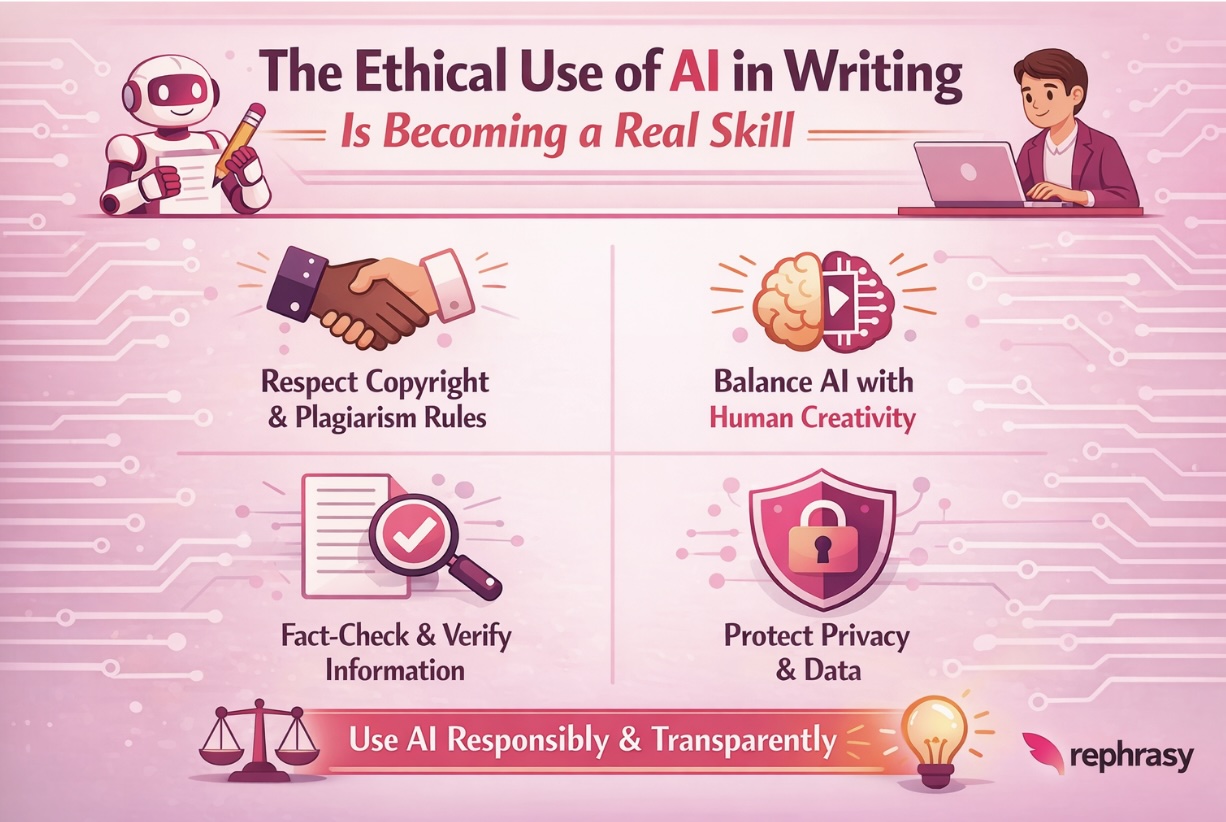
Using AI responsibly is now part of being a good writer, especially as policies and expectations continue to evolve.
A few years ago, ethical discussions around AI were mostly theoretical. Now they are practical. Writers are being judged not just on what they write but also on how they write it. The ethical use of ai in writing is quickly becoming part of professional credibility.
Is AI writing considered plagiarism or something else?
AI writing is not automatically plagiarism, but it can become problematic if not properly edited or verified. This mainly depends on how it’s actually used. AI writing becomes really risky when:
It closely mirrors existing material
Writers fail to verify originality
Facts are copied without checking sources
No meaningful changes have been made
So, the real question here remains simply whether AI writing is considered plagiarism. And no, not automatically, but careless use of it can actually create similar consequences.
When AI crosses into unethical territory
AI becomes unethical when it replaces effort, misleads readers, or is used without responsibility. Most writers will very much so know anytime they are crossing the line. The most common examples here would include the following:
Submitting fully AI-generated academic work
Publishing unverified information
Pretending expertise they do not have
Mass-producing low-value content
At this point, what you should recognise is that ethical use usually comes down to one question, and it’s whether you are using AI to support your work, or simply looking to replace your entire responsibility?
The difference between smart assistance and academic dishonesty
One secret that we’ll let you in on is that smart assistance will always appear as using AI to understand the main concept and then using it to write the content yourself to further clarify the concept. On the other hand, academic dishonesty will usually look like simply generating, submitting, and then hoping for the best, which is something that you should NOT do.
AI Detectors vs AI Humanizers
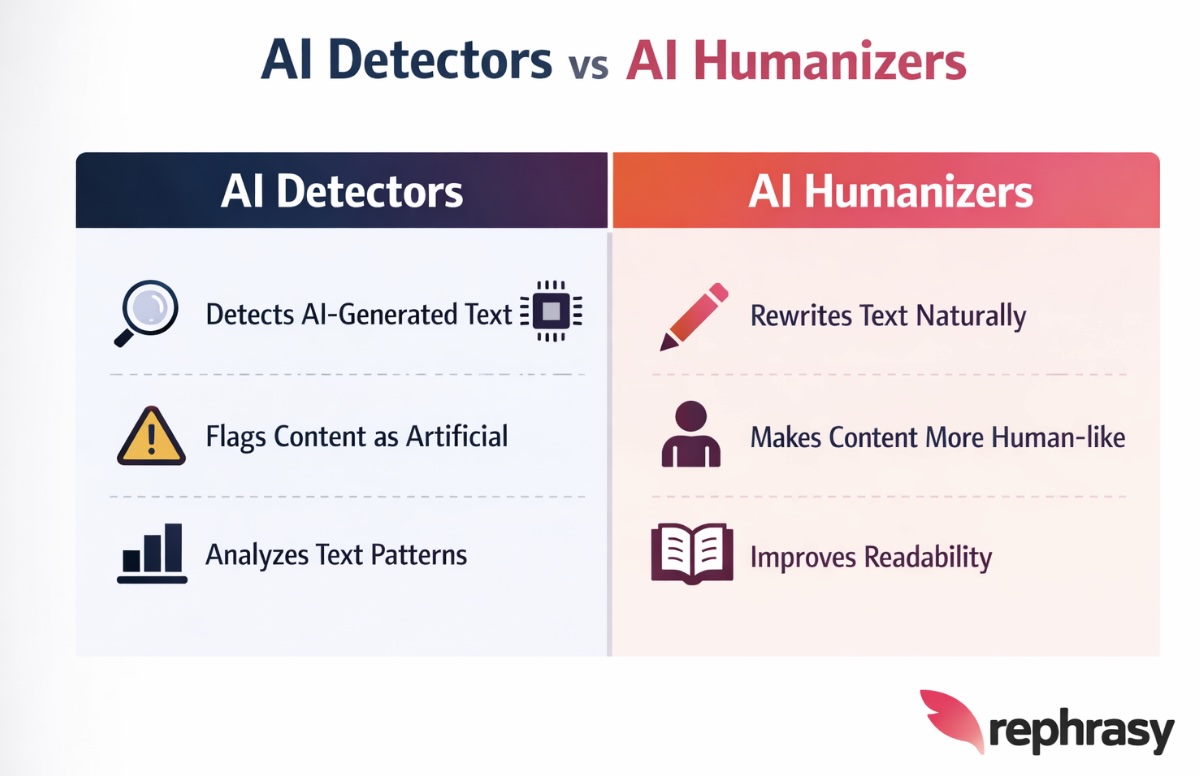
Most writers eventually realise that improving content quality works better than trying to outsmart detection tools.
A strange arms race has formed between detection tools and rewriting tools. On one side you have detectors trying to identify patterns. On the other hand, you have tools trying to improve how text reads. This has created the discussion around AI detectors vs. AI humanizers.
But most experienced writers eventually realize something important and it’s simply that better writing solves more problems than better hiding.
Why AI detectors are not always reliable
One thing that you should always keep in mind is that detection tools always work on probability. What this means is that human text can still be flagged, and AI text can still pass through.
AI detectors vs AI humanizers explained simply
Want to know the main difference? It’s a simple focus. Detectors will always focus on identifying patterns, while humanizers will focus on improving the general text quality. One will judge you, and the other will always try to improve your mistakes. This is why so many writers will prefer to focus on tools that can improve clarity rather than tools that only score content.
Can AI humanizers bypass Turnitin or is that the wrong question?
Many people have this general question in their mind on whether AI humanizer bypass Turnitin or not? But experienced writers will always tend to ask something different, and it’s that can this make my writing sound more natural? Note that this mindset shift changes everything, as when writing genuinely improves, detection usually becomes less of a concern.
Why are many writers searching for the best AI humanizers
Writers want to sound as real as possible, and this is why they avoid trying to sound robotic. During all of this, the best AI humanizers will help you by restructuring your sentences, improving overall flow, removing any kind of predictable phrasing and making the writing feel a lot more conversational.
How Writers Are Converting AI Drafts Into Natural Human Content
The real skill today is not generating AI text but turning it into something that reads naturally.
Perhaps the most effective AI users aren’t really prompt engineers, and it’s simply that they are brilliant editors. Their real skill is turning rough AI drafts into something that is insanely natural. This is often described as being an AI to human text workflow.
The AI-to-human text workflow is now used by many professionals
Note that a common workflow will look something like this, where you draft with AI, rewrite manually, improve tone, add examples, and then make final edits to make sure it’s all good to go. Notice that generation here is just one step, while you as a human actually transform everything properly.
Why rewriting improves originality more than prompting
Many beginners will try to fix AI writing by writing better prompts, while experienced writers will just rewrite the existing content instead. Why’s that? Because rewriting will more often than not:
Where an AI detector remover fits into a real editing process
Some writers will use an AI detector remover as part of their editing process, but not really as a simple shortcut. Instead, they will always use it after making improvements to see if anything still reads unnaturally. Used this way, it becomes an easy quality check rather than a loophole.
Understanding AI Content Policy and AI Content Regulation in 2026
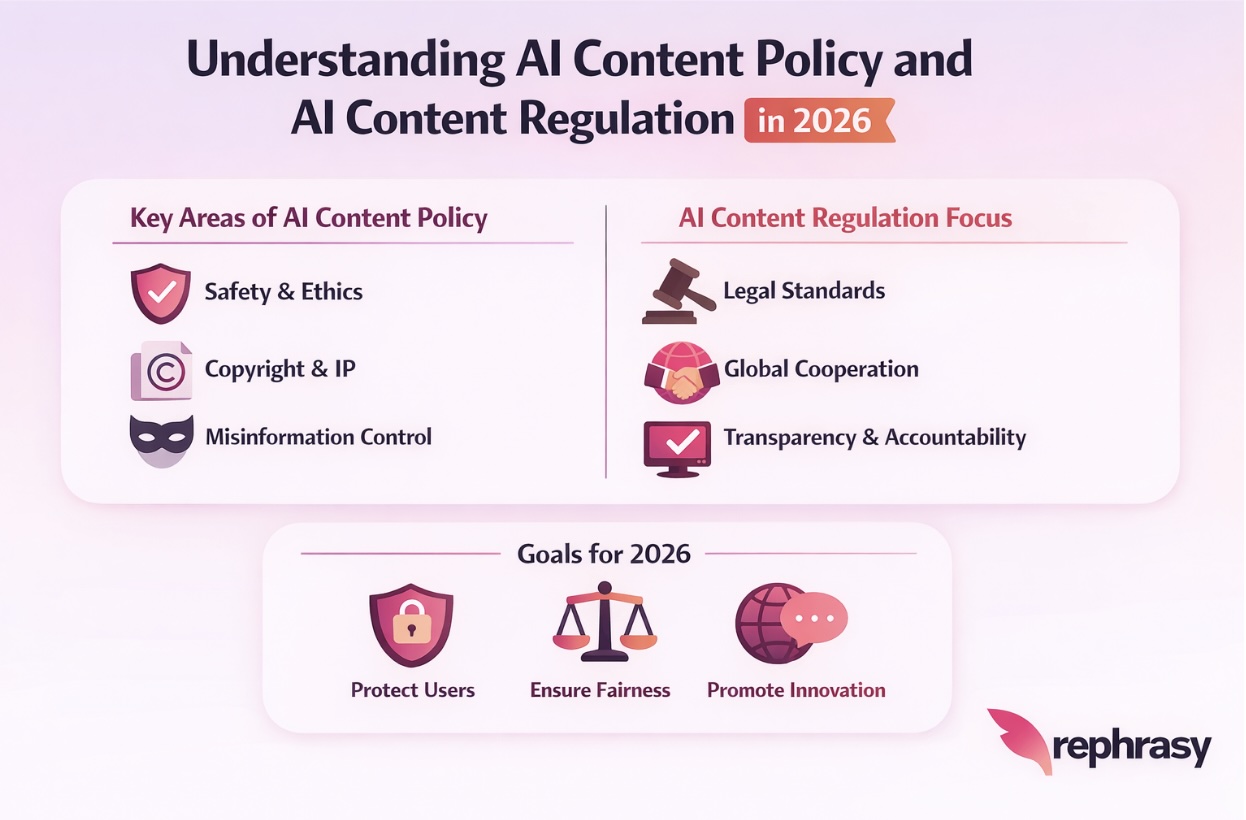
AI rules are changing quickly, but most policies now focus more on responsible use than banning AI completely. The reality here is that rules around AI writing are very much still in the process of evolving, but most policies are moving towards similar ideas.
What search engines actually care about
Search engines will never penalize AI itself, as it instead penalizes the following:
Thin content
Spam content
Unhelpful content
Misleading content
What this means is that AI usage is probably safe if the end-quality production is still very high.
How academic AI content policy is evolving
Many institutions will now allow limited AI use with expectations such as students who understand the material, who edit work and who maintain overall originality.
A Simple Framework To Know If You Are Using Too Much AI
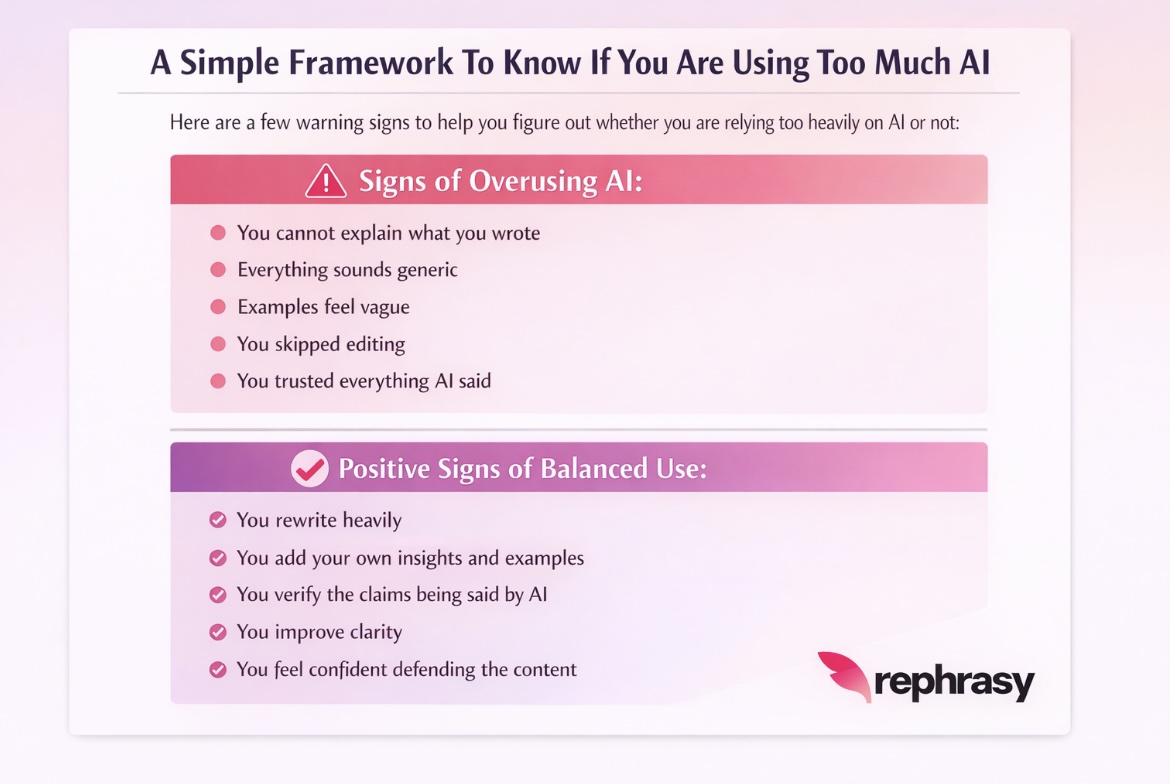
If AI is going the thinking instead of helping you express ideas, you’re probably using too much of it. There is always bound to be a simple framework that can generally help you figure out whether you are using too much AI or not. On the other hand, a simple mental model works a whole lot better.
A practical decision test writers can use
Ask yourself this simple question: Did AI help me properly express what I already understand? This question alone will help you catch most problems. Here are a few warning signs to help you figure out whether you are relying too heavily on AI or not:
You cannot explain what you wrote
Everything sounds generic
Examples feel vague
You skipped editing
You trusted everything AI said
On the flip side, here are a few positive signs, which include the following:
You rewrite heavily
You add your own insights and examples
You verify the claims being said by AI
You improve clarity
You feel confident defending the content
Why Tools Like Rephrasy.ai Are Becoming Part of Modern Writing Workflows
As AI writing becomes very natural, rewriting tools will become all the more important. Though the real issue here will be that of refining content, not just generation, but this is where tools like Rephrasy.ai naturally fit in, as they can rewrite content for you that you never even thought could be rewritten.
FAQs
1. Is AI writing considered plagiarism in 2026?
No, not really, as AI writing is not plagiarism by default, but it can become risky if you ever submit unedited AI content or fail to check originality.
2. What is the ethical use of AI in writing?
The main ethical use of AI in writing simply means using AI to assist your work, not to replace your thinking.
3. What do current AI content policy rules usually allow?
Most AI content policy guidelines allow AI for research, outlining, and editing but expect humans to review and take responsibility for the final content.
4. How do writers make AI content sound more natural?
Writers will usually end up rewriting AI drafts, simplifying sentences, adding examples, and improving flow to make the text sound more human.
5. Will AI content regulation become stricter in the future?
Yes, most likely, AI content regulation will likely grow, but the focus will mostly remain on content quality and responsible use rather than banning AI completely.
Conclusion
AI is acceptable when it improves your workflow, but not when it truly replaces your judgement or responsibility. If you are looking for a strict number, you probably will not find one. There is no official percentage that defines just how much AI is acceptable. What matters more is how the technology is used and how much human thinking remains in the final result.
In 2026, AI-assisted content creation is mainly accepted anytime it truly supports the writing process rather than simply replacing it. Writers who use AI to brainstorm, structure ideas, and improve readability are generally on safe ground. Problems usually start when AI does all the thinking and the human simply presses publish.
A good rule many professionals follow is simple. If you can confidently explain, defend, and improve what you wrote without relying on the AI output, then the answer is that you are probably using it correctly. If you cannot, then you may be relying on it too much.
The conversation is also shifting away from detection and more towards that of general responsibility. Strong writers focus less on trying to beat AI checkers and more on following AI writing best practices that make their content useful, accurate, and readable.
The real future of AI writing is mainly all about using it well. Writers who learn how to combine AI efficiency with human editing, personal insight, and ethical use of AI in writing will always produce stronger content than those who depend on automation alone. So now that your real question of how much AI is acceptable in writing in 2026 is answered, write carefully!