Artificial intelligence writing tools are now widely being used all the way for simple stuff like blogs, essays, and complex marketing content, and research assistance. However, one thing to note is that raw AI text often sounds ends up sounding pretty predictable, structured, and sometimes unnatural. This is where rewriting and humanizing tools enter the workflow. While many people assume these tools do the same thing, they actually solve different problems.
A rewriter mainly focuses on changing wording while keeping the meaning intact. A humanizer focuses on improving tone, flow, and natural readability so content feels genuinely written by a person. When comparing AI detectors vs AI humanizers, this difference becomes especially important because not all rewritten content actually sounds human.
Our guide will properly explain for you about just how both tools work, when to use each one, and how to integrate them into a professional writing process. Ready to learn? Let’s get started!
What is an AI humanizer?
Simply put, an AI humanizer is a rather useful tool that has been basically designed to make AI-generated text sound more natural, conversational, and all the more human-written.
The reality is that most type of AI content often follows predictable structures, balanced sentence lengths, and safe vocabulary choices. Humanizers attempt to correct this by introducing variation, tone adjustments, and more natural phrasing patterns. The goal is not just rewriting but improving authenticity.
Many writers who search for the best AI humanizers, or even about bypassing university AI detectors are usually trying to solve readability problems first. Detection concerns often come later. The real value of humanization is that it improves engagement, clarity, and trustworthiness before anything else.
Humanizing content also improves SEO performance because search engines increasingly reward helpful, readable content. Content that feels mechanical often struggles to keep readers engaged, which affects bounce rates and time on page.
How AI humanizers actually work
The easiest way to understand this system is that AI humanizers basically just analyse structure patterns instead of just replacing words. What they do is to often:
Break repetitive sentence patterns
Replace predictable transitions
Improve rhythm and readability
Add conversational phrasing
Adjust tone variation
This is also mainly why many AI-to-human text tools tend to focus pretty heavily on structuring the general sentences rather than just replacing the synonym.
When should you use an AI humanizer?
You should mainly use a humanizer anytime your content feels a bit robotic or lacks any kind of personality. The most typical use cases would include editing AI blog drafts, improving marketing copy, making academic explanations easier, or even improving the overall readability for SEO purposes.
What is an AI rewriter?
Moving on, an AI rewriter is a tool that changes wording and structure while keeping the original meaning intact.
Rewriters are typically used to paraphrase content, avoid duplication, or simplify complex writing, but anywhere unlike humanizers, they will always focus more on varying the language than tone improvement.
Many writers mistakenly think rewriting automatically improves quality. In reality, rewriting without humanizing can still produce content that feels mechanical. Rewriters are useful during drafting stages but are rarely enough on their own for final publishing quality.
How AI rewriting tools process content
AI rewriters usually tend to rely on paraphrasing models that have been trained on a variety of languages. Common rewriting changes include the following:
When should you use an AI rewriter?
You should use a rewriter anytime you need variation rather than personality improvement. At this point, the best thing to do is to paraphrase any research notes, reduce any kind of repetition, improve clarity, adjust the reading level, or even simplify explanations that are rather technical.
AI humanizer vs AI rewriter: What is the main difference?
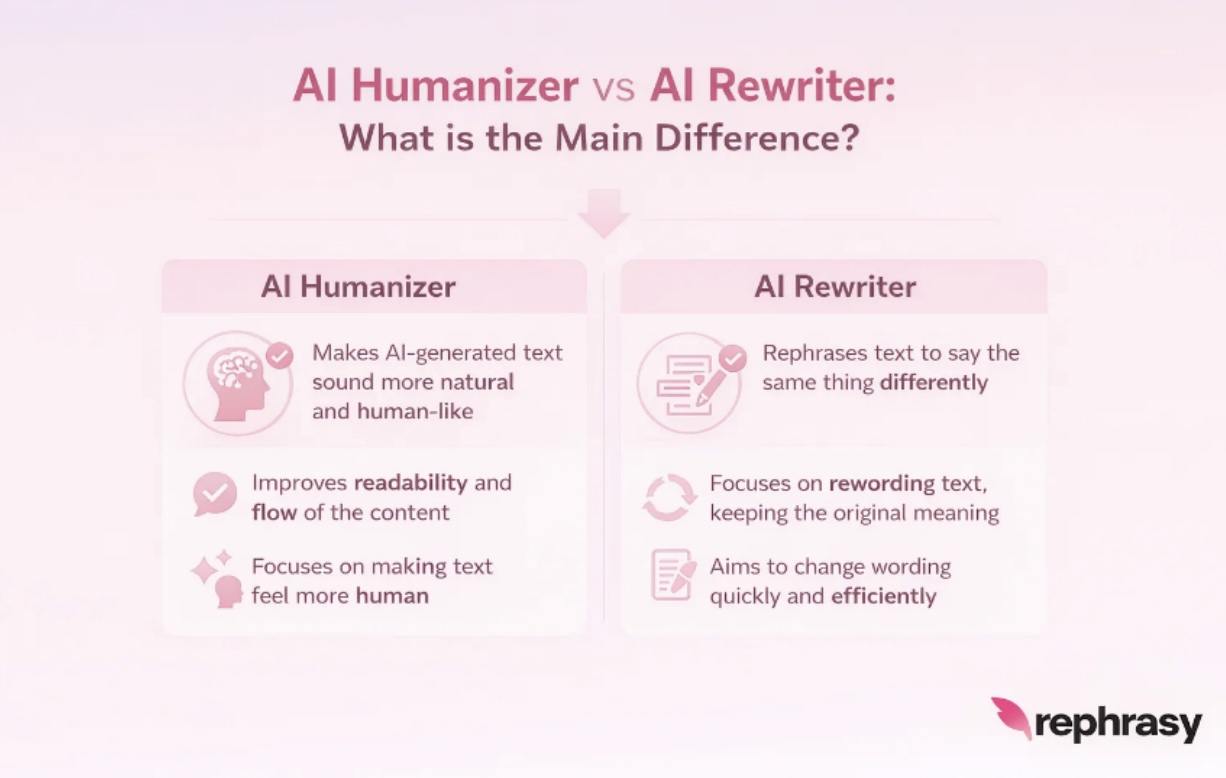
The main difference is simply that rewriters change wording while humanizers improve authenticity and natural readability. Many beginners tend to try rewriting multiple times anytime the real problem is tone, while others will try to humanize when the real need here is to paraphrase it. Here’s how you can understand it properly:
Feature
| AI Humanizer
| AI Rewriter
|
Primary goal
| Improve natural tone
| Change the wording
|
Focus area
| Readability and personality
| Linguistic variation
|
SEO benefit
| Improves engagement
| Reduces any duplication
|
Detection impact
| May reduce AI signals
| Minimal impact alone
|
Best workflow stage
| Final polishing
| Early editing
|
Which tool is better for avoiding AI detection risks?
Humanizers are generally more effective simply because they will always end up changing writing patterns rather than just wording.
Detection systems always analyze statistical writing patterns rather than just phrases, and this is mainly why simple rewriting often does not change detection probability much. Humanizing changes rhythm and variation, which can affect how content appears structurally.
This is also why many discussions about AI humanizers bypassing Turnitin don't explain how detection works. No tool guarantees bypassing detection because these systems work on probability signals, not fixed rules. Remember that instead of focusing only on avoidance, writers should focus on improving originality and authenticity.
Why rewriting alone often fails detection checks
Rewriting tools may keep similar structure patterns even after wording changes. Detection tools often still see predictable paragraph flow, low variation of styles, balanced sentence lengths, or consistent structure patterns. On a rather interesting note, this would also explain just why many writers combine rewriting with AI detector removers that focus on deeper editing.
Best practice approach
A safer approach is to just go ahead and combine many different methods, like rewriting to make things clearer, humanizing for tone, editing manually, as well as adding your own general but original insights.
Should you use both tools together?
The answer is yes, as combining both tools will often produce the best results because they solve different problems. One thing to note is that professional content workflows rarely depend on one tool. Instead, writers will always move through stages such as drafting, rewriting, humanizing, and then editing manually.
The best way to go about the process is to generate your draft with AI, then rewrite to make concepts clear, humanize the tone if needed, add personal insights, and then doing a final manual edit.
How to choose between an AI humanizer and an AI rewriter
The right choice depends on your content problem rather than the tool itself. Writers will often choose tools that are basically based on popularity instead of need, and a better approach here is to always diagnose the main issue at hand first. Does the content sound too repetitive? Rewrite it! Sounding robotic? Humanize it all!
Also, you can always ask yourself a few basic questions to help keep a mental checklist, like:
How humanized content improves SEO performance
Humanized content improves SEO because it increases reader engagement and clarity.
Search engines have been increasingly measuring the general user interaction signals. Content that sounds natural keeps readers engaged longer, and what this does is that it basically also improves dwell time and reduces bounce rates. Humanized writing also tends to answer questions more directly, which improves search relevance. This makes it useful for writers building authoritative content.
SEO benefits of humanized writing
Humanized content often improves your readability scores, improves user trust, increases the session time, enhances any clarity, and also just generally reduces any bounce rates.
Common mistakes when using AI rewriting and humanizing tools
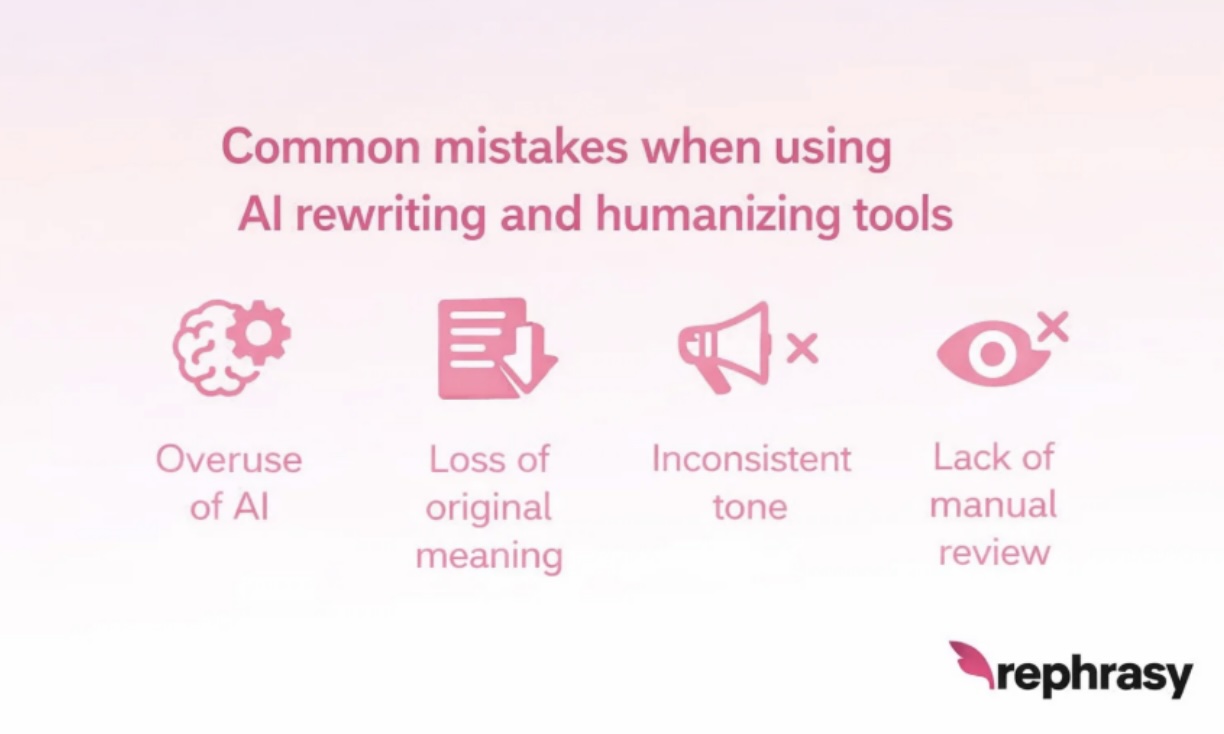
Most problems come from over-reliance on automation instead of using tools strategically. Many writers expect tools to produce perfect content instantly. In reality, these tools are editing assistants, not replacements for human judgment. Mistakes usually happen anytime users skip manual review stages.
Most common workflow mistakes
Do you want to know about the most common workflow mistakes? These would include using only one tool, ignoring the accuracy of the facts you’ve presented, over-editing until the meaning has completely changed, or even not adding your original perspective on things.
How to properly edit AI content after rewriting or humanizing
Manual editing is what ultimately determines whether content feels authentic. Even the best automated tools cannot fully replicate human judgment. Editing allows you to add nuance, clarity, and logical flow improvements. Writers who rely entirely on automation often produce content that feels generic even after processing.
Are AI humanizers ethical to use?
Yes, if they’re mainly used in order to improve the clarity rather than misinterpret the idea of authorship. Remember that ethical concerns will always depend on your own intent, and using any kind of AI tools will only improve readability, which is similar to using grammar tools.
The main problem arises when users attempt to misrepresent work as their own and entirely original without contributing any effort from their own side.
Ethical guidelines for using AI editing tools
Here are a few simple principles you should be following:
Conclusion
Both tools are really valuable, but they truly do serve different purposes when you’re looking at it from a professional writing perspective. Rewriters help reshape structure and wording. Humanizers improve authenticity and readability. The strongest workflows combine both rather than treating them as alternatives.
Writers who end up properly understanding this difference will always produce better content, improve their SEO results, and then also maintain higher quality standards. The best approach is to stay strategic and remember that the AI humanizer vs AI rewriter battle will never end!
FAQs
1) Is an AI humanizer better than an AI rewriter?
Neither is universally better because they solve different problems. Rewriters help change wording while humanizers improve natural tone and readability. Most professional workflows benefit from using both tools together.
2) Can AI humanizers remove AI detection completely?
No tool can guarantee the complete removal of detection signals because detection systems rely on probability models. The safest method is combining editing, humanizing, and original writing rather than relying on automation.
3) Do SEO writers use AI humanizers?
Yes, many SEO writers use humanizers to improve readability and engagement. This helps content perform better with readers and search engines by improving clarity and flow.
4) Should I manually edit after using AI tools?
Yes, manual editing is always recommended, as AI tools only end up helping to basically improve drafts, but human review ensures accuracy, clarity, and originality.
5) Can rewriting alone make content sound human?
Not, not really, as rewriting basically changes wording but may not improve tone. Humanizing or manual editing is usually needed to achieve natural-sounding content.