How to Remove Claude’s AI Watermark from Text: What We Know So Far
Anthropic has announced that new Claude models will embed invisible, machine-readable watermarks in AI-generated text.
Rephrasy Team
Aug 12, 2026
Anthropic has announced that new Claude models will embed invisible, machine-readable watermarks in AI-generated text.
Rephrasy Team
Aug 12, 2026
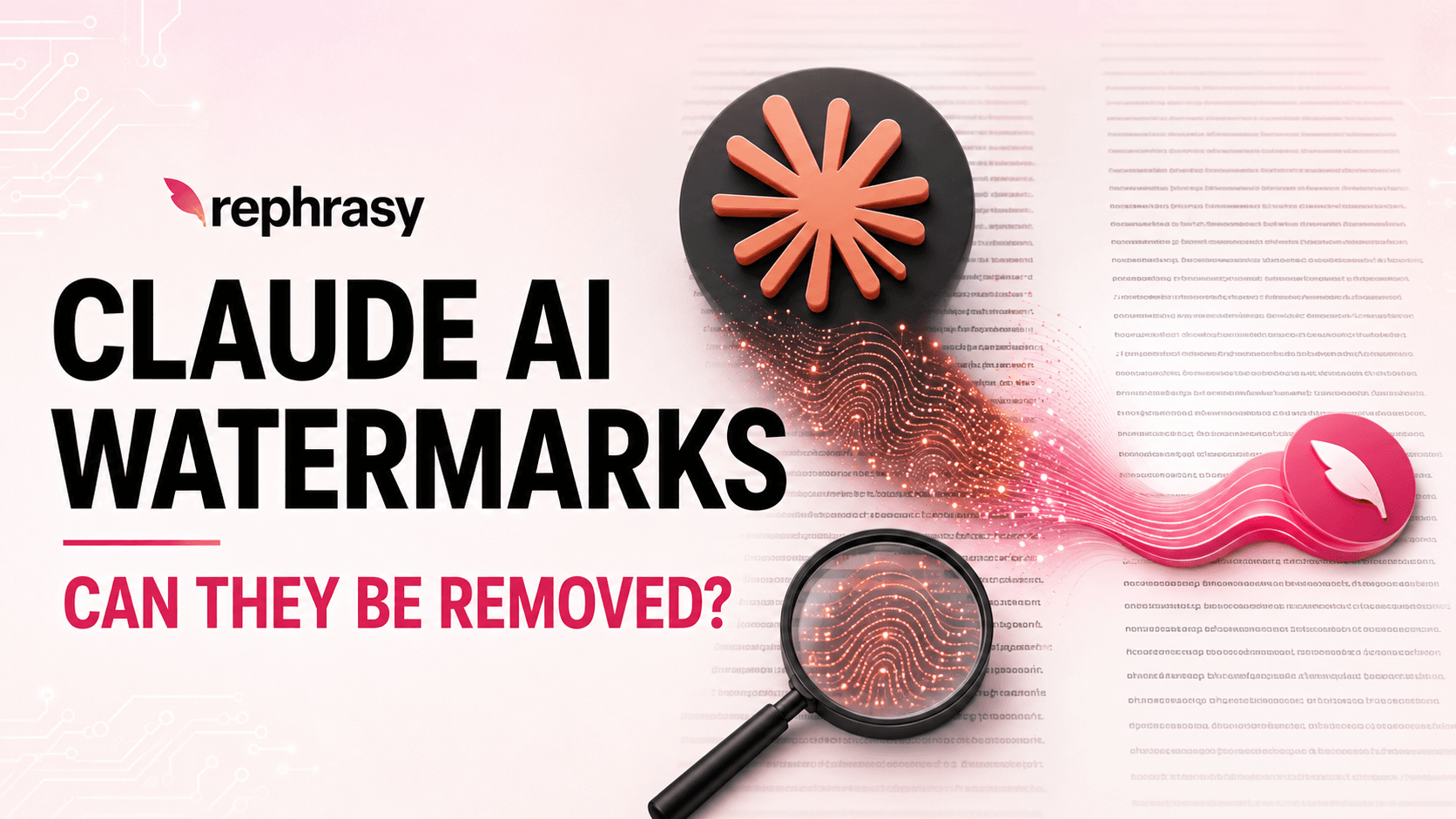
Unlike a visible label or a piece of metadata, this watermark is woven directly into the generated text and may remain present when the text is copied and pasted.
The change raises an obvious question for writers, developers, students, and businesses using Claude:
Can Claude’s AI watermark be detected or removed from text?
The short answer is that substantial rewriting may remove or weaken the watermark. Anthropic disclosed the method in August 2026 and opened a detection API on 1 September, but access is restricted to accredited organisations - so removal still cannot be independently verified.
Here is what we know so far, how Claude’s watermark works, and how Rephrasy is preparing to test it.
Claude’s AI watermark is an invisible signal embedded in text generated by supported Claude models. According to Anthropic, it does not visibly change the meaning, quality, or readability of the response.
Because the mark is part of the generated text itself, it can travel with the content when someone:
Copies and pastes a Claude response
Publishes it on a website
Adds it to a document
Uses it inside another application
Generates content through the Claude API
This is different from metadata attached to a file. Removing formatting, pasting the text into a plain-text editor, or exporting it into another document may not remove an embedded text watermark.
Anthropic is also adding signed provenance metadata to supported files such as PNG, JPG, and SVG files. That metadata uses the C2PA standard and is separate from the watermark embedded in written text.
Anthropic says it is implementing these measures to support transparency and comply with commitments related to Article 50(2) of the EU AI Act’s Code of Practice on Transparency of AI-Generated Content.
New Claude models launched on or after August 2, 2026 will support machine-readable marking from launch. Anthropic is also working to introduce marking support for models released before that date.
Importantly, the system will not be limited to users in the European Union.
Anthropic says the watermark will apply worldwide wherever supported Claude models are available, including:
Claude
Claude Platform and the Claude API
Claude Code
Claude Cowork
Claude Tag
Supported access through AWS, Google Cloud, and Microsoft Foundry
This means developers using Claude inside their own products may receive watermarked output as well.
Potentially, yes - but reliable removal cannot currently be confirmed.
Anthropic acknowledges that a Claude watermark may no longer be detectable when text has been:
Heavily edited
Paraphrased
Translated
Combined with other writing
Reduced to a short excerpt
This suggests that genuine rewriting may alter enough of the original output to weaken or remove the embedded signal.
Anthropic disclosed the mechanism on 14 August 2026: Claude's text watermark is a version of SynthID-Text, the scheme Google DeepMind published in Nature in 2024. A secret key nudges which of several near-equivalent words the model picks at each step, leaving a statistical pattern that anyone holding the key can test for. On 1 September 2026 Anthropic released a detection API - but in private preview, limited to organisations with an EU AI Act reason to verify. There is no public detector.
Without access to an official or independently validated Claude watermark detector, it is impossible to confirm whether a particular rewritten passage still contains a detectable mark.
Anyone currently claiming to remove Claude’s new watermark with guaranteed reliability is making a claim that cannot yet be independently verified.
No. Simply copying Claude’s response into another application is not expected to remove the watermark.
Anthropic specifically states that the embedded watermark travels with copied text. The mark is not described as a collection of invisible Unicode characters that can be removed with a basic formatting tool.
The following actions are therefore unlikely to be sufficient on their own:
Pasting the text into Notepad or another plain-text editor
Removing formatting
Changing the font
Exporting the text to another document format
Removing file metadata
Copying the text between websites
A meaningful rewrite is more likely to affect the watermark than a change to the text’s formatting or file type.
No.
Anthropic explicitly warns that detecting a Claude watermark does not conclusively establish the complete origin of a text.
Claude may have been used only to:
Proofread human-written content
Translate an original document
Improve grammar
Summarize existing material
Reformat or restructure a file
In those situations, the underlying ideas and original writing may come from a person, even though the resulting text contains a Claude watermark.
A detected watermark indicates that the content may have been processed by Claude. It does not automatically prove that Claude created the original work.
The reverse is also true: failing to detect a watermark does not prove that a text was written by a human.
An AI humanizer does more than change formatting or replace a few individual words. It reconstructs sentences, varies language patterns, and rewrites the text while attempting to preserve its meaning.
Because Anthropic acknowledges that substantial paraphrasing and editing may make its watermark undetectable, a high-quality humanizer could potentially remove or weaken the signal.
The result will depend on several factors:
How Claude embeds the watermark
How much text is required for reliable detection
How extensively the original content is rewritten
Whether the watermark survives generation by another model
How Anthropic's detector handles modified text
Whether the detector produces false positives or false negatives
These questions cannot be answered properly until detection access broadens beyond Anthropic's private preview.
At Rephrasy, we believe claims about AI detection and watermark removal should be based on repeatable testing- not assumptions.
As soon as we can access Claude watermark detection, we plan to run controlled experiments using text generated by supported Claude models. Our new Humanizer model v4 was trained on a similar process and achieved great results.
The testing process will compare:
Original Claude-generated text
Lightly edited Claude text
Claude text rewritten with Rephrasy
Text processed multiple times
Human-written control samples
Mixed human and AI-assisted writing
Different text lengths and writing styles
We will measure whether Claude’s watermark remains detectable after each transformation. Where necessary, the results will be used to improve and fine-tune future Rephrasy models.
We also intend to publish the results transparently, including cases where the watermark survives.
Claude text watermark announced:
Yes
Applied to supported new models:
Yes
Official detection system publicly available:
Private preview only, since 1 Sep 2026
Independent removal verification possible:
Not yet - detector access is restricted
Rephrasy compatibility testing:
Pending detection access
Last updated:
September 1, 2026
This page will be updated when detection access broadens or Anthropic publishes additional technical guidance.
Rephrasy will continue improving its humanization models against evolving AI-detection methods and provenance systems.
No responsible AI humanizer can promise permanent undetectability against every present and future detector. Detection tools, language models, and watermarking systems continuously change.
Our approach is to:
Test against newly released detection systems
Measure results using previously unseen documents
Fine-tune our models using real test data
Preserve the original meaning, facts, and intent
Publish meaningful results instead of relying on unsupported claims
If Claude’s watermark remains present after ordinary rewriting, we will use those findings to adapt our models.
If you are concerned about Claude’s watermark, avoid relying on simple formatting changes or metadata removal. These actions are not designed to alter a watermark embedded directly in text.
Instead:
Treat Claude’s response as a draft rather than a finished document.
Review every claim and factual statement.
Rewrite the content in your own voice.
Add your own reasoning, examples, and experiences.
Restructure sections rather than replacing isolated words.
Keep records of your original drafts when authorship matters.
Wait for independently verifiable testing before trusting watermark-removal guarantees.
Rephrasy users can already rewrite Claude-generated drafts into more natural language. However, we will not claim verified removal of Claude’s new watermark until an appropriate detection method is available.
Anthropic says supported Claude models launched on or after August 2, 2026 include embedded text watermarks. Support for older models is still being developed.
No. Anthropic describes it as an imperceptible, machine-readable watermark embedded in generated text.
No. Anthropic says the watermark can travel with the text when it is copied and pasted.
Not necessarily. Metadata removal may affect provenance information attached to files, but Claude’s text watermark is embedded in the text itself.
Anthropic acknowledges that heavily edited or paraphrased text may no longer carry a detectable watermark. The amount of rewriting required is currently unknown.
Rephrasy substantially rewrites text, which may affect embedded watermark signals. Reliable removal cannot yet be verified because Anthropic's detector is limited to a private preview we do not have access to. Rephrasy will publish controlled results when testing becomes possible.
A detected watermark only indicates that content may have been processed by Claude. The original material could still have been written by a person and later proofread, translated, or formatted using Claude.
Claude’s new AI watermark is real, invisible, and embedded directly in supported model outputs. It is expected to apply worldwide across Claude’s consumer products, API, coding tools, and supported cloud platforms.
Anthropic’s own documentation indicates that substantial editing, paraphrasing, translation, or combining the text with other writing may make the watermark undetectable. What remains unknown is how much rewriting is required and how reliably the detection system will work.
Rephrasy will test the system as soon as independent detection becomes possible. If Claude’s watermark survives existing humanization methods, we will use the results to improve and fine-tune our models.
Until then, claims of guaranteed Claude watermark removal should be treated cautiously.
Try Rephrasy to transform AI-generated drafts into more natural writing while preserving their original meaning.
Source: Anthropic — How Claude marks AI-generated content, Reddit discussion, Anthropic - How Claude's text watermarking works (updated 1 September 2026)
Convert AI to Human Text — Free AI Humanizer
The #1 AI humanizer trusted by 200,000+ students & professionals