At the same time sttudies found that 74% of new webpages contain some level of AI-generated content, and even 86% of top-ranking pages include AI-written elements
So the question is not whether to use AI. It’s how you use it.
Publishing raw AI drafts leads to problems. In healthcare or legal, it can introduce factual errors, outdated guidance, or misleading claims. In marketing and SEO, it results in thin content, poor rankings, and loss of brand authority because the writing feels generic and repetitive.
Yes, A certain level of AI writing is now becoming acceptable in online spaces, but only after a rigorous editorial process.
To turn an AI draft into publication-ready content, you need to fix structure, verify facts, remove generic language, and rewrite it with a clear voice. Tools like Rephrasy help speed up this process by improving tone and readability, but the real value comes from how you refine the draft.
Let’s break down this process step by step.
Step 1: Check Whether the Draft Actually Answers the Intent
Before editing anything, read the entire piece once without making changes. The goal is to understand what the draft is trying to say and whether it actually answers the reader's question.
Define the core intent
Identify what the reader expects to learn. AI drafts tend to give broad explanations instead of direct answers, and the main point is often buried in the middle.
Once you find it, move it to the top. The first section should deliver the answer clearly and without delay. This improves both readability and SEO.
Flag issues before you start editing
As you review, mark three things:
Factual claims that need verification
Generic or repetitive phrases
Structural gaps where ideas feel incomplete
Note what needs attention. You will act on all of it in the next step.
Step 2: Rebuild the Structure Before Editing the Sentences
You have flagged what is weak. Now act on it, before touching a single sentence.
This is where most editors go wrong. They start polishing language inside a structure that does not work, then wonder why the article still feels off. Rewriting sentences inside a broken structure is wasted effort.
Reorder Headings for Logical Flow
Read only the headings in sequence, without the body content. They should tell a clear story on their own, moving from problem to context to solution to action.
Suppose they do not, reorganize them. Move sections that appear too early or too late. Merge headings that overlap in meaning. Cut any heading that exists just to break up text rather than signal a distinct idea.
If someone read only your headings, would they understand the full argument? If not, the structure is not ready.
Create a Clear Section-by-Section Narrative
Each section should have a single job: to introduce, explain, or prove a single point. When a section tries to do more than that, it becomes bloated and hard to edit later.
Once the order is right, check how the sections connect. The last sentence of each section should lead naturally into the next. If the transition feels abrupt, one bridging sentence is enough. Do not over-explain the connection; just make it smooth enough that the reader keeps moving.
When this step is done, your draft has a clear intent and a logical sequence. Now you are ready to go line by line.
Step 3: Verify Every Fact and Statistic
Your structure is solid, and your sections are in order. Now they should be accurate as well.
The next logical step is to check the content in that existing section is actually providing accurate information and not misleading.
This step exists because of one specific problem with AI drafts: they hallucinate confidently. They will provide you with a statistic that will have a plausible number or a study that will have a real-sounding source, but you need to take this information with a grain of salt because a surprising amount of it will be fabricated or distorted.
If you polish sentences built on false information, you will have to rewrite them anyway once the errors surface. This is why you should always verify first and edit second.
Identify AI Hallucinations
Go through every claim that relies on external information. This includes statistics, percentages, study references, named sources, quotes, and any statement presented as fact.
Treat all of it as unverified until you have checked it yourself. Do not assume something is correct because it sounds precise. Specific numbers and named institutions are exactly where AI drafts tend to fabricate most confidently.
Verify Against Primary Sources
For every claim you flag, find the original source, and that is not a blog that cited it, but the actual study, report, or publication it came from.
You can always ask AI to cite the source it is using the data from, and manually cross-check it.
If the source exists and the claim is accurate, link to it directly. If the source exists but the number has been misrepresented, correct it.
Replace or Remove Anything Unverifiable
If you cannot confirm a claim, do not keep it. Either find a verified stat that makes the same point or remove the claim entirely.
A sentence without a source is better than a sentence with a wrong one. Unverified claims are a liability in any content, but especially in healthcare, legal, or financial topics, where inaccurate information can cause real harm with legal consequences.
Once every remaining claim in the draft is verified and sourced, you are ready to work on the language itself.
It is also important that while citing the information from another source, make sure you are not plagiarizing it. We have discussed how to avoid plagiarism here
Step 4: Strip Out Generic Language
Accurate and well-structured content can still fail if it reads like every other AI draft. Originality is the solution to this problem.
Identify the Vocabulary AI Defaults To
Research analyzing millions of texts has consistently flagged the same words appearing at unusually high rates in AI-generated content. Terms like "delve," "underscore," "meticulous," and "boast" showed some of the highest increases in AI-influenced writing. Other frequently flagged words include "intricate," "tapestry," "realm," "cutting-edge," "pivotal," "bolster," "holistic," and "transformative."
GPTZero's analysis found that phrases like "today's digital age," "despite facing," and "research needed to understand" are hundreds of times more likely to appear in AI writing than in human writing.
Scan your draft for these. They are not wrong; they are just signals that the writing was never genuinely thought through.
Watch for Structural AI Formulas
Individual words are only part of the problem. AI drafts also follow recognizable sentence-level patterns:
Stacked transition words: opening consecutive paragraphs with "Furthermore," "Moreover," "Additionally," "Notably", each one adding nothing
The hedge opener: "It is important to note," "It is worth mentioning," "It goes without saying," these are preambles that delay the actual point
The unlock formula: "Harness the power of," "Unlock the potential of," "Navigate the complexities of", these action framing that sounds dynamic but says nothing specific
Cut these on sight. Replace them with direct statements that actually carry information.
Replace Vague Claims With Specific Ones
Vagueness is usually a sign of an incomplete thought. "AI improves content quality" is not a point; it is the beginning of one. Push it further by answering questions such as
which part of quality, in what context, and how?
This will not only make your content thematically rich and deep but also give the reader real value.
Step 5: Rewrite With a Clear Voice and Point of View
By this point, the draft is accurate, structured, and clean. What it still lacks is a reason to trust the person behind it. This step is about replacing AI's default neutrality with a perspective that is specific to you.
Rewrite Neutral Sentences Into Positioned Ones
AI defaults to presenting information without committing to it. The fix is mechanical: find the sentence, identify the implied position, and state it directly.
Take a sentence like: "There are several approaches to editing AI content, each with its own advantages."
That sentence says nothing. Push it: which approach works best, in what situation, and why do others fall short? Rewrite it as a claim you can actually defend: "Most editing frameworks fail because they treat AI errors as a language problem when they are usually a structure problem."
Do this for the main claim in each section. You do not need to take a position on everything — just the points where your experience gives you something more specific to say than the neutral version.
Insert First-Person Observations at the Right Moments
Personal observations work best at three points in an article: after a claim that needs grounding, before a section that feels abstract, or at the end of a point you want the reader to remember.
The format is simple: state the observation in one sentence, then connect it back to the point you are making. "In practice, most teams skip the structure check entirely and go straight to sentence edits, which is exactly why the article still feels off after two rounds of revision."
That is it. One sentence that could only come from experience, placed where it earns the most weight.
Break the Sentence Pattern AI Relies On
AI produces uniformly structured sentences of similar length and rhythm throughout. This is one of the most reliable signals of unedited output, and readers feel it subconsciously.
Read a paragraph and count the sentence lengths. If they are all roughly the same, break the pattern deliberately. Follow a long sentence with a short one. Cut a compound sentence into two. Occasionally, let one land alone.
Like that.
Varied rhythm is how writing holds attention at the sentence level, and it is something AI drafts seldom do on their own.
Step 6: Optimize for SEO Without Over-Optimizing
At this stage the draft reads well. It is clear, structured, and human. Now it needs to be optimized for search engines and LLMs.
Most AI drafts already include the keyword. The problem is placement. It gets forced into sentences or repeated too often because the prompt asked for "SEO optimization." The result is writing that reads like it was built around a keyword rather than a topic.
Check Keyword Placement
Your primary keyword should appear in
After that, stop counting. Read each paragraph where the keyword appears and ask whether it belongs there. If removing it makes the sentence read better, rewrite the sentence until it fits without forcing it.
Rewrite the Title and Meta Description
AI titles tend to be too broad or overcomplicated. A strong title is simple, it tells the reader exactly what they will get and includes the keyword without making it feel placed by formula.
The meta description is not a summary. It is what makes someone click. One test: after reading it, does the reader know what they will gain from the article? If not, rewrite it until the answer is yes.
Audit Internal Links and Headings
Add internal links where they genuinely help the reader go deeper. For example, if your article covers AI detection or rewriting, linking to a dedicated guide like how to make AI text undetectable gives the reader a natural next step without feeling like a detour.
Every heading should clearly reflect what its section delivers. If a heading feels vague when you read it in isolation, rewrite it. Vague headings are missed signals for both readers and search crawlers.
Step 7: Run the Draft Through an AI Humanizer
At this point most people stop. The structure is solid, the facts are verified, and the writing is clean. But something still feels slightly off — and most editors cannot name exactly what it is.
That feeling is almost always a rhythm problem.
AI writing produces uniform sentence lengths, predictable constructions, and consistent flow throughout. Each sentence works on its own. Read together, they produce a flatness that makes the whole piece feel assembled rather than written.
What a Humanizer Actually Does
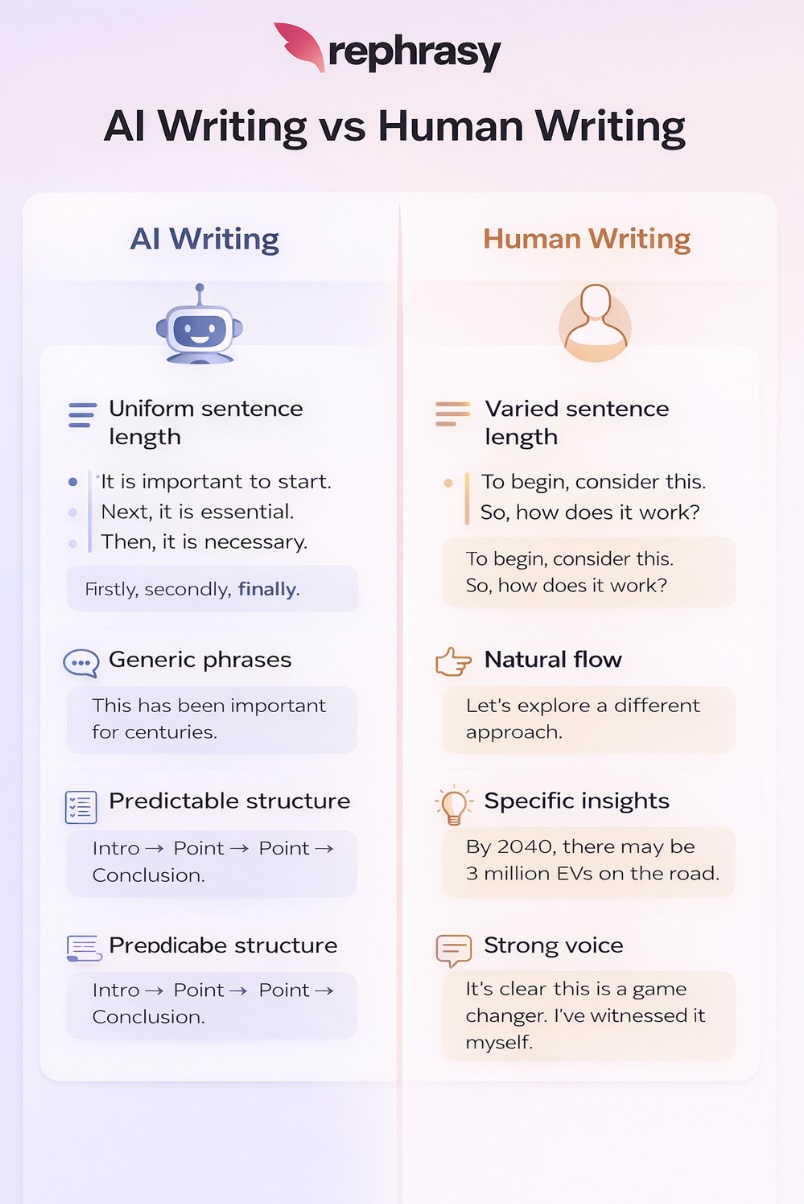
Rephrasy identifies the structural patterns that make AI writing detectable. These include repetitive sentence construction, predictable phrasing, and uniform rhythm. Rephrasy then rewrites them so the content reads naturally from start to finish. It does not change your meaning or rewrite your argument. It fixes how the writing feels without touching what it says.
Step 8: Final Checklist Before Publishing
This is the last pass, just a structured check that catches what most editors miss because they are too close to the draft by this point.
Readability
Check how the content looks on mobile, where most readers will find it. A paragraph that looks fine on a desktop becomes a wall of text on a phone. If a paragraph runs longer than four sentences, find the natural break and split it there.
Consistency of Voice
Read the full article once with one question in mind: does this sound like one person wrote it? After multiple rounds of editing across different sections, tone often shifts in ways that are easy to miss mid-edit but obvious to a first-time reader. Fix any section where the voice noticeably changes before it goes live.
Reading out loud works better than reading on screen for this check, your ear catches tone shifts that your eye skips over.
AI Detection and Accuracy Check
Run the final draft through an AI detector to identify sections that still read as unedited output. If a section scores high, it means the humanization work in Steps 5 and 7 did not fully reach it. Go back and add specificity, adjust the sentence rhythm, or rewrite the transitions.
For a deeper look at what AI detectors actually measure and where they get it wrong, this breakdown is worth reading before you treat any score as a final verdict.
When the checklist is clear, the article is ready to publish.
Conclusion: AI Writes the Draft. You Make It Worth Reading.
AI gives you speed and structure. It does not give you judgment, verified facts, or a perspective that means something to the reader. That comes from editing which is the entire point of this process.
The goal was never to hide that AI was involved. It was to make sure the final article meets the standard your reader expects, regardless of how the draft started.
If you want to move through that process faster without cutting corners, Rephrasy is where the final layer of that refinement happens.
That is what turns a draft into something worth publishing.