How do AI Detectors work?
AI Detectors are commonly used in universities, schools and other public institutions. But not only there, but also Google and other big companies use AI Detection in their services!

Rephrasy Team
Oct 10, 2024
AI Detectors are commonly used in universities, schools and other public institutions. But not only there, but also Google and other big companies use AI Detection in their services!
Rephrasy Team
Oct 10, 2024
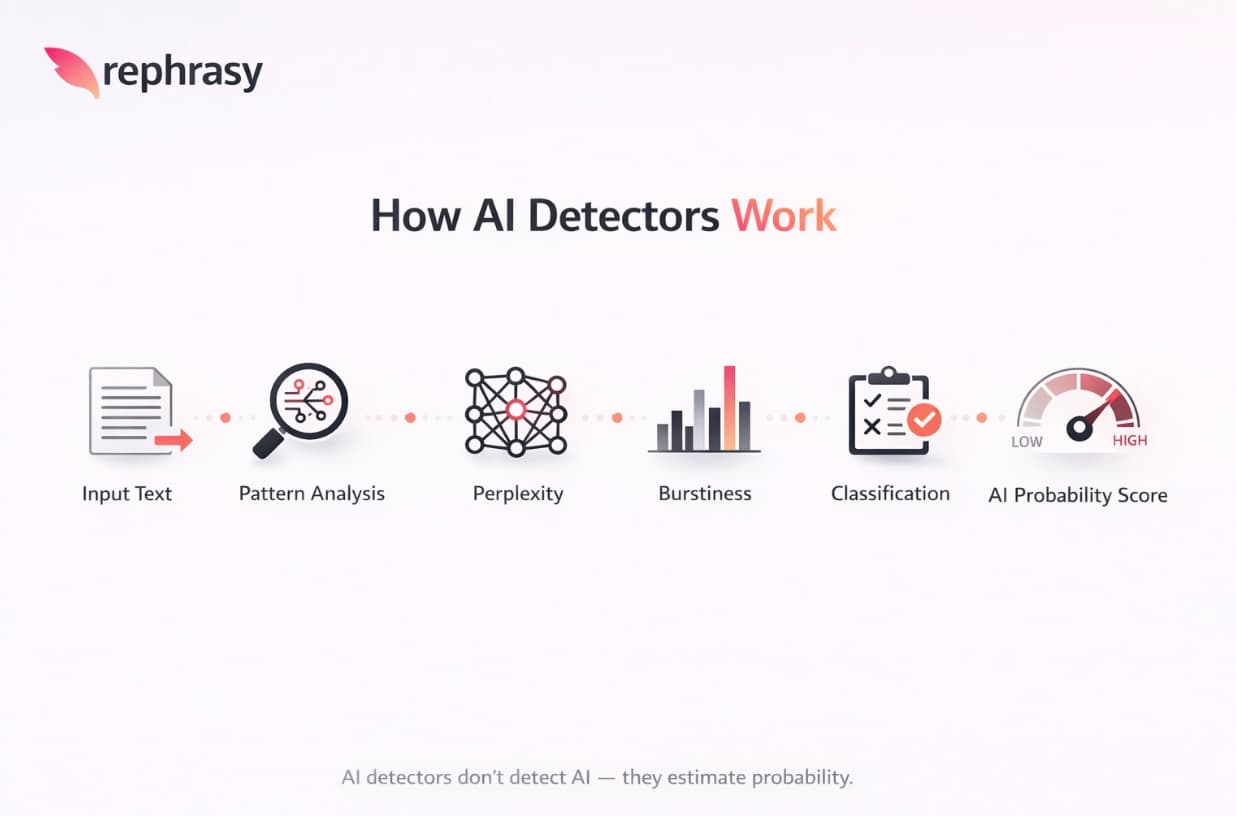
AI detectors matter more in 2026 because AI writing is now everywhere. Students use it for assignments, marketers for content, and professionals for daily writing tasks.
As usage grows, so does the need to check how content is created. That’s why universities, publishers, recruiters, and SEO teams are using AI detection tools more frequently. But there’s still confusion. Many people think detectors can definitively identify AI writing. In reality, they estimate probability, not certainty.
Many modern detectors also use techniques like style analysis, consistency checking, and anomaly detection to identify unusual phrasing patterns that differ from typical human writing behaviour.
This article explains how AI detectors actually work, how accurate they are, where they fail, and why edited AI content is harder to detect. It also looks at how writers adapt their workflows using editing and rewriting tools like Rephrasy.ai.
AI detectors are tools that estimate whether text was generated by AI. They don’t “detect AI” directly. Instead, they analyze patterns in writing and assign a likelihood score.
Common tools include ZeroGPT, GPTZero, Turnitin, and Grammarly AI detection.
They look at things like sentence predictability based on statistical data, the structure of content, and repetition of certain patterns.
Based on these signals, they estimate whether the text resembles AI-generated content.
One key point: results are not definitive. A high score does not prove AI use. It only suggests that the text follows patterns often seen in AI writing.
AI detectors are used in:
Education for checking assignments
Publishing companies use them for content review
SEO experts for content audits
Because of their limitations, most professionals treat them as indicators, not proof.
AI writing tools have made content creation extremely fast. What used to take hours can now be done in minutes.
This created a new challenge: how do you know who actually wrote something?
For example, in education, the focus is on learning. Schools want to ensure students understand their work.
Whereas in the publishing and SEO business, it is about the quality and depth of content, as the raw AI content often feels generic or lacks depth.
People working in Human Resources are now receiving written tests with heavy AI writing, and thus, they can't actually assess the capabilities of applicants.
This shift also changed the focus from plagiarism to authorship. It’s no longer just about copied content, but whether the content was generated by an LLM or not.
At the same time, writers are adapting. Instead of using raw AI output, they edit and rewrite it. Tools like Rephrasy.ai help improve structure and reduce predictable patterns.
If you want to see how these tools perform against detection systems, this breakdown is useful:
AI detectors don’t “understand” content the way humans do. They look for patterns. More specifically, they analyze how predictable, structured, and repetitive a piece of writing is.
Most tools rely on machine learning models trained on both human-written and AI-generated text. Over time, these models learn the subtle differences between the two. When new text is analyzed, the detector compares it against those learned patterns and assigns a probability score.
The key idea is simple: AI writing tends to follow consistent, predictable structures. Human writing, on the other hand, is usually more varied and less uniform.
At the core of AI detection are classifiers. These are machine learning models trained to sort text into categories, usually “AI-generated” or “human-written.”
To do this, they are trained on large datasets that include both types of writing. During training, the model learns common patterns—how sentences are structured, how often certain phrases appear, and how predictable the wording is.
When new text is submitted, the classifier checks for those same patterns. If the structure closely matches what it has seen in AI-generated content, it increases the probability score.
Many detection systems are built on transformer-based language models similar to those used in AI writing tools, which explains why detection methods continue evolving as generation models improve.
It’s important to understand that classifiers don’t actually “know” who wrote the text. They simply recognize patterns that tend to appear more often in machine-generated writing.
Perplexity is a measure of how predictable a piece of text is.
AI models generate text by predicting the most likely next word in a sentence. Because of this, their output often follows very common and expected patterns. The result is writing that reads smoothly but is statistically predictable.
Human writing behaves differently. People make less predictable word choices. They might change tone mid-paragraph, use unusual phrasing, or introduce ideas in unexpected ways.
When a detector finds text with very low perplexity—meaning it can easily predict what comes next—it may flag it as AI-generated. Not because it’s certain, but because the structure aligns with how AI typically writes.
Burstiness refers to variation in sentence length and structure.
Human writing naturally shifts in rhythm. Some sentences are short and direct. Others are longer and more detailed. This variation creates a more dynamic and uneven flow.
AI writing often lacks this variation. Sentences tend to be similar in length and follow consistent structures. The rhythm feels balanced, sometimes too balanced.
Detectors look for this difference. If a paragraph has very little variation—same sentence length, same structure—it may signal low burstiness. That’s a common trait in AI-generated text.
Higher burstiness, on the other hand, is usually associated with human writing.
Another key signal is repetition in language and structure.
AI-generated text often relies on familiar phrases and transitions. You’ll see patterns like repeated sentence openings, predictable connectors, or formulaic explanations. The content may be clear, but it can feel slightly mechanical.
Human writing tends to vary more. Even when explaining the same idea, people naturally change how they phrase things.
AI detectors look for these repeated patterns. They don’t evaluate meaning deeply. Instead, they track how often certain structures appear and how similar sentences are to each other.
When repetition and uniform phrasing show up consistently, the detector may interpret that as a sign of AI-generated content.
Raw AI-generated content is easier to detect because its patterns remain intact. The structure is consistent, the rhythm is balanced, and the phrasing often follows predictable paths. These are exactly the signals detectors are trained to identify.
Once a human edits the text, those patterns begin to break.
Sentence Restructuring: One of the biggest changes comes from sentence restructuring. When sentences are rewritten, merged, or shortened, the original rhythm shifts. This increases variation and makes the text less uniform.
Predictability: Editing also affects predictability. Adding context, examples, or small clarifications introduces elements that AI models may not have generated in the same way. This changes how predictable the text appears statistically.
Pattern Disruption: AI detectors rely on consistency across paragraphs. When a writer rewrites sections in their own style, that consistency weakens. The text becomes harder to classify.
Mix Signals: In many cases, content becomes a mix of AI and human input. This hybrid structure creates conflicting signals. Some parts may still resemble AI output, while others reflect natural human variation. That’s why the same piece of content can produce different detection scores before and after editing.
In practice, this shows that detection is not fixed. As more human input is added, the reliability of detection decreases. This also explains why ongoing research focuses on detecting rewritten AI content, as editing workflows continue to challenge how reliably detectors can identify machine-assisted writing.
AI detectors are useful, but they are not fully reliable. They estimate probability, not certainty, which means mistakes can happen. Accuracy can also depend on factors such as the diversity of training data, the writing domain being analyzed, and how quickly detection models adapt to newer AI writing styles.
One common issue is false positives, where human-written content is flagged as AI. This often happens when writing is very structured, formal, or repetitive. On the other hand, false negatives occur when AI-generated content passes as human, especially after editing.
Accuracy depends on several factors. Text length plays a role. Short passages don’t provide enough data for reliable analysis. Writing style also matters. Simplified or highly consistent writing can resemble AI patterns.
Most importantly, editing affects results. Once content is rewritten, original AI patterns become less visible, making detection less consistent.
Research has also shown that rewriting and paraphrasing can reduce detection accuracy, even when the original meaning stays the same.
For high-stakes decisions such as academic evaluation or publishing review, detection results are usually combined with human judgment rather than used as standalone decisions. Because of these limitations, AI detectors should be treated as indicators rather than proof. A high score suggests similarity to AI writing patterns, not definitive evidence of AI use.

Most experienced writers don’t rely on raw AI output. They treat it as a draft and focus on editing.
A typical workflow starts with generating a draft, followed by manual rewriting. Instead of changing a few words, writers restructure sentences entirely. This breaks predictable patterns that detectors rely on.
Another key step is varying sentence structure. Mixing short and long sentences creates a more natural rhythm. This improves burstiness, which is a common signal of human writing.
Writers also add context and explanation. AI drafts often stay general. Adding small details, examples, or clarifications makes the content less predictable and more specific.
Tone refinement is equally important. Adjusting phrasing to sound more natural reduces the mechanical feel often found in AI-generated text.
Some writers use tools like Rephrasy.ai to speed up this process. These tools help rewrite content by introducing variation in structure and phrasing, making the text flow more naturally before final edits.
If you want a deeper look at how this workflow is used in academic contexts, this guide explains it step by step.
In practice, the key is simple. The more effort put into editing, the less predictable the writing becomes.
AI detectors and AI humanizers serve opposite roles, even though both are built around analyzing language patterns.
Detectors are designed to identify patterns and Humanizers do the reverse. They transform those patterns. Instead of flagging predictable phrasing, they rewrite it. They adjust sentence structure, introduce variation, and reduce repetition so the writing feels more natural.
This is why humanizer tools have emerged alongside detection systems. As detectors became more common, writers needed a way to refine AI drafts without rewriting everything manually.
In practice, humanizers help by:
Breaking repetitive phrasing
Varying sentence length and flow
Restructuring predictable patterns
Improving readability without changing meaning
However, automated humanizing tools do not always produce consistent results, which is why testing rewritten content and applying manual review remains important.
For example, tools like Rephrasy.ai don’t just swap words. They rewrite sentence structure itself, which matters because detectors rely more on structure than vocabulary.
If you want to see how these tools perform in real scenarios, this comparison provides useful insights.
Used correctly, humanizers are not shortcuts. They are part of a broader editing process.
Aspect | AI Detectors | AI Humanizers |
Core Purpose | Identify AI-like patterns | Rewrite and improve patterns |
How They Work | Analyze predictability, structure, repetition | Restructure sentences and vary phrasing |
Output | Probability score (AI vs human likelihood) | Rewritten, more natural text |
Focus | Detection and classification | Transformation and readability |
Strength | Spotting statistical signals | Reducing those same signals |
Limitation | Not fully accurate, probabilistic | Requires human review for quality |
Role in Workflow | Final check or audit step | Editing and refinement step |
In simple terms, detectors flag patterns, while humanizers fix them.
Most writers today don’t start from a blank page. They start with an AI draft.
The challenge comes after that. Raw AI content is often clear but predictable. Before publishing or submitting, it needs to be rewritten so it feels natural.
This is where Rephrasy.ai fits into the workflow.
Instead of editing everything manually from scratch, writers use it to reshape the draft quickly, then refine it further. The tool focuses on structural changes rather than surface-level edits.
It helps:
Break repetitive sentence patterns
Improve flow between ideas
Reduce predictable phrasing
Maintain the original meaning while changing the structure
A common workflow looks like this: generate a draft, run it through Rephrasy.ai, then apply final manual edits. This saves time while still keeping control over tone and accuracy.
What makes this approach practical is that it doesn’t replace writing—it supports it. The final quality still depends on human review.
In that sense, Rephrasy.ai works best as part of a broader editing process, not as a one-step solution.
AI detection is improving, but so is AI generation. Both are evolving simultaneously.
Early detection tools aimed to answer a simple question: was this written by AI or not? In practice, that has proven difficult. As models become more advanced and editing workflows improve, the distinction becomes less clear.
Because both AI writing and detection models are updated frequently, detection techniques can change rapidly, creating a continuous cycle of improvement between content generation and detection technology.
This has turned detection into something closer to an arms race. Better AI produces more natural text. Better detectors try to identify subtler patterns.
At the same time, many organizations are shifting their approach.
Instead of relying only on detection scores, they are focusing more on:
Content quality
Authorship transparency
Editorial review processes
For example, some universities now combine detection tools with draft reviews and writing discussions rather than relying on automated scores alone.
The direction is clear. Detection will remain useful, but it will not be the only measure.
Long term, human judgment still plays the central role. Clear thinking, accurate information, and well-structured writing matter more than whether a tool flags a piece of text.
AI detectors analyze writing patterns such as predictability, sentence structure, and repetition. They compare these patterns to known examples of AI and human writing to estimate the likelihood of AI involvement.
They are not fully accurate. Results vary depending on text length, writing style, and editing. Most tools provide probability scores, not definitive answers.
Human writing can sometimes match AI-like patterns, especially if it is very structured, repetitive, or formal. This can lead to false positives.
Yes. When AI-generated text is rewritten, its original patterns change. This often reduces detection signals and leads to lower AI probability scores.
They can help by rewriting predictable structures and improving variation. Tools like Rephrasy.ai are often used alongside manual editing to make content read more naturally.
AI detectors rely on statistical signals, not certainty. They look for patterns that commonly appear in machine-generated text, but those patterns can change.
Once AI content is edited through rewriting, restructuring, and adding context, it becomes less predictable. As a result, detection scores often shift.
This is why the most effective approach is not trying to outsmart detection systems. It is improving the writing itself.
Clear structure, varied sentences, and meaningful context naturally reduce the signals that detectors rely on.
Tools like Rephrasy.ai can support this process, but the final quality always depends on human input.
In the end, strong writing matters more than detection scores.
Convert AI to Human Text — Free AI Humanizer
The #1 AI humanizer trusted by 200,000+ students & professionals